
electronics-journal.com
26
'26
Written on Modified on
SiC Power Semiconductors for Electrified Systems
ROHM will present power conversion technologies at PCIM Europe 2026 for electric mobility, industrial power systems, renewable energy, and AI infrastructure.
www.rohm.com
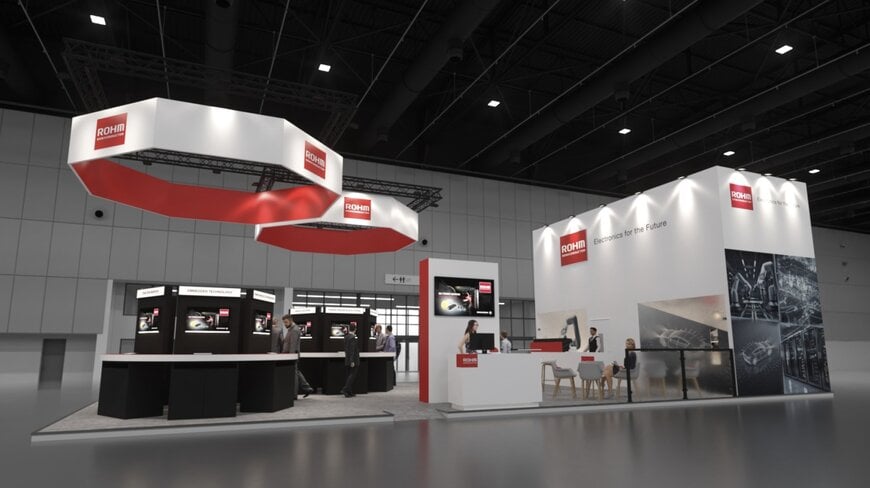
Power semiconductor architectures are evolving in response to higher efficiency requirements in electric vehicles, industrial power conversion, renewable energy systems, and AI data infrastructure. At PCIM Europe 2026, ROHM will present its latest silicon carbide and gallium nitride technologies aimed at reducing switching losses, increasing power density, and supporting compact power electronics design.
Power Electronics Focus at PCIM Europe 2026
PCIM Expo & Conference 2026 will take place from 9–11 June 2026 in Nuremberg, Germany, bringing together suppliers and system developers across power electronics, intelligent motion control, renewable energy, and energy management. ROHM’s participation reflects the increasing strategic role of wide-bandgap semiconductors in automotive electrification and industrial power infrastructure.
The company will exhibit in Hall 9, Booth 318, where the focus will be on application-driven semiconductor technologies rather than standalone component announcements.
Why SiC and GaN Matter in Modern Power Conversion
Power electronics designers are increasingly adopting silicon carbide (SiC) and gallium nitride (GaN) devices because conventional silicon architectures face efficiency and thermal limitations at higher switching frequencies and power densities.
SiC devices are particularly relevant in high-voltage systems such as traction inverters, onboard chargers, renewable energy inverters, and industrial power supplies because lower switching losses and higher thermal tolerance can reduce cooling requirements and enable smaller converter architectures. GaN technologies, meanwhile, are increasingly used in fast-switching power supplies where compact size and high-frequency operation are critical.
These technologies are central to broader electrification trends, including electric mobility and digital infrastructure power optimization.
Automotive Electrification Applications
ROHM’s demonstrations will cover several automotive electrification subsystems, including traction inverters, onboard chargers, battery disconnect architectures, EV thermal management systems, and embedded automotive electronics.
These applications are technically significant because each subsystem imposes different semiconductor design constraints. Traction inverters require high-voltage switching efficiency and thermal robustness, while onboard chargers prioritize conversion efficiency and compact packaging. Battery disconnect systems must support safe switching under fault conditions, while thermal management systems increasingly depend on efficient power control electronics.
The automotive sector’s transition toward higher-voltage EV platforms is accelerating demand for advanced semiconductor switching technologies.
Industrial and Digital Infrastructure Power Systems
Beyond automotive applications, ROHM will present power technologies for industrial automation, renewable energy conversion, AI servers, data centers, and industrial power supplies.
AI infrastructure is becoming a particularly important application area because high-density compute environments significantly increase power conversion demands. Server power architectures increasingly require higher efficiency AC-DC and DC-DC conversion to reduce operational energy losses and thermal overhead.
Renewable energy systems similarly benefit from high-efficiency switching devices capable of supporting inverter and energy conversion functions at higher voltages and switching frequencies.
Application-Oriented Power Module Design
ROHM also plans to highlight power modules, discrete semiconductor devices, and power conversion topologies developed through global engineering partnerships.
This reflects a broader market shift away from component-only differentiation toward system-level semiconductor integration, where module packaging, switching topology optimization, thermal design, and interface compatibility increasingly determine deployment performance.
Edited by Aishwarya Mambet, Induportals Editor, with AI assistance.
www.rohm.com
