
electronics-journal.com
26
'26
Written on Modified on
Power Semiconductors for AI, Robotics, and Energy Infrastructure
Infineon will present semiconductor platforms at PCIM Europe 2026 targeting data center power conversion, industrial automation, electromobility, and resilient power infrastructure.
www.infineon.com
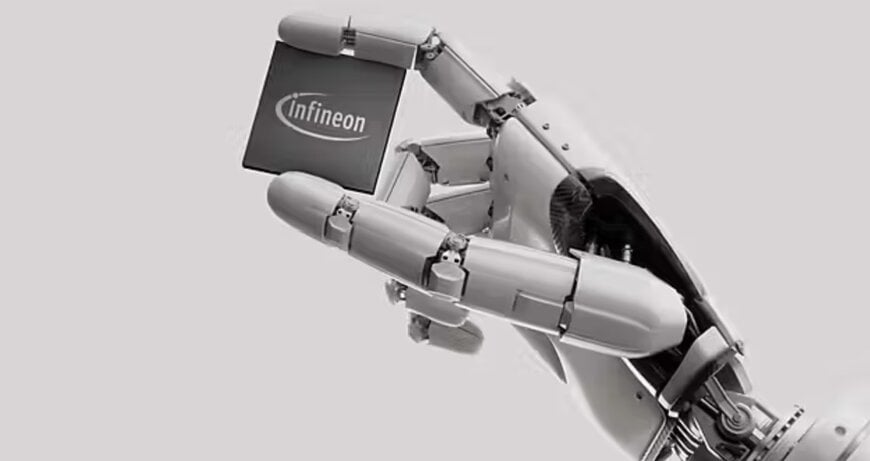
Power semiconductor design is increasingly shaped by electrification, AI-driven compute demand, and the modernization of industrial energy infrastructure. At PCIM Europe 2026, Infineon Technologies AG will present a broad semiconductor portfolio spanning silicon, silicon carbide, and gallium nitride technologies, alongside software and cybersecurity capabilities, reflecting the growing integration of power electronics with digital infrastructure.
Power Electronics Strategy at PCIM Europe 2026
PCIM Europe 2026 will take place from 9–11 June 2026 in Nuremberg, Germany, bringing together suppliers, system architects, and engineers focused on power electronics, energy management, and intelligent motion control. Infineon will exhibit in Hall 7, Booth 470, with demonstrations centered on system-level power conversion architectures rather than individual semiconductor component launches.
The company’s showcase spans four major application domains: grid infrastructure, AI data centers, electromobility, and robotics. This aligns with broader industrial trends where power electronics increasingly determine system efficiency, thermal performance, fault resilience, and compliance readiness.
Semiconductor Architectures for Power Infrastructure Modernization
Power infrastructure is under pressure from increasing electrification loads, distributed renewable generation, and higher resilience requirements. Infineon’s demonstrations in this area focus on battery energy storage systems, uninterruptible power supplies, solid-state transformers, and solid-state circuit breakers.
Solid-state transformers are gaining attention because they replace conventional low-frequency transformer architectures with semiconductor-based power conversion stages, enabling bidirectional power flow, higher switching frequencies, and improved integration with DC-based energy systems.
The company will also demonstrate solid-state circuit breaker technology using silicon carbide JFET-based architectures. These systems are relevant for emerging DC microgrid applications because fault isolation must occur substantially faster than with conventional electromechanical protection systems. Infineon states its SSCB components support fault isolation within microseconds, which is critical in protecting high-power DC infrastructure.
AI Data Center Power Conversion and Digital Infrastructure
AI data center growth is reshaping power conversion architecture. High-density accelerator workloads are increasing energy demand while pushing infrastructure operators toward higher-efficiency distribution architectures, including HVDC sidecar systems and DC microgrids.
Infineon’s PCIM demonstrations will cover semiconductor building blocks across the power chain, from grid interconnection to processor-level voltage regulation. These include power semiconductors, gate drivers, microcontrollers, sensors, battery backup solutions, intermediate bus converters, and intelligent protection devices.
This reflects a practical engineering shift: AI infrastructure increasingly requires tighter control over conversion losses, thermal density, and power delivery efficiency, particularly where multiple conversion stages can compound energy waste.
Automotive Power Electronics for Electromobility
Infineon will also present semiconductor solutions for traction inverters, DC-DC converters, onboard chargers, and battery management systems.
These application areas remain central to EV platform design because each subsystem imposes distinct switching, thermal, and control requirements. Traction inverters require efficient high-voltage switching under heavy load, onboard chargers prioritize conversion efficiency and packaging density, while battery management systems require precision sensing and safety control.
The company’s integrated inverter reference architecture indicates a continuing industry move toward consolidated drivetrain power electronics, where semiconductor integration affects system footprint, efficiency, and design complexity.
Robotics Power and Motion Control Systems
Robotics represents another expanding semiconductor application area, particularly as systems evolve toward sensor-rich autonomous platforms.
Infineon’s robotics demonstrations include motor control, power management, microcontroller-based control architectures, and sensor integration for industrial robots, domestic automation systems, humanoid platforms, and drones.
In robotic systems, semiconductor efficiency directly influences thermal constraints, battery life, actuator responsiveness, and form factor. Gallium nitride power devices are particularly relevant where compact switching architectures and reduced conversion losses support higher-performance motion control.
Cybersecurity Compliance in Embedded Power Systems
A notable element of Infineon’s PCIM participation is its focus on the EU Cyber Resilience Act.
As industrial electronics become increasingly network-connected, cybersecurity is moving from software-layer consideration to embedded hardware design. Infineon indicates that its semiconductor strategy includes secured-by-design architectures intended to support regulatory compliance.
For OEMs developing connected industrial, automotive, and infrastructure systems, cybersecurity increasingly intersects with semiconductor selection, particularly where lifecycle risk and certification requirements are relevant.
Edited by Aishwarya Mambet, Induportals Editor, with AI assistance.
www.infineon.com
