
electronics-journal.com
05
'26
Written on Modified on
ROHM presents second-generation Terahertz Wave Oscillation Device
To address the growing demand for improved signal quality in application development, ROHM has now developed a second-generation terahertz wave oscillation device.
www.rohm.com
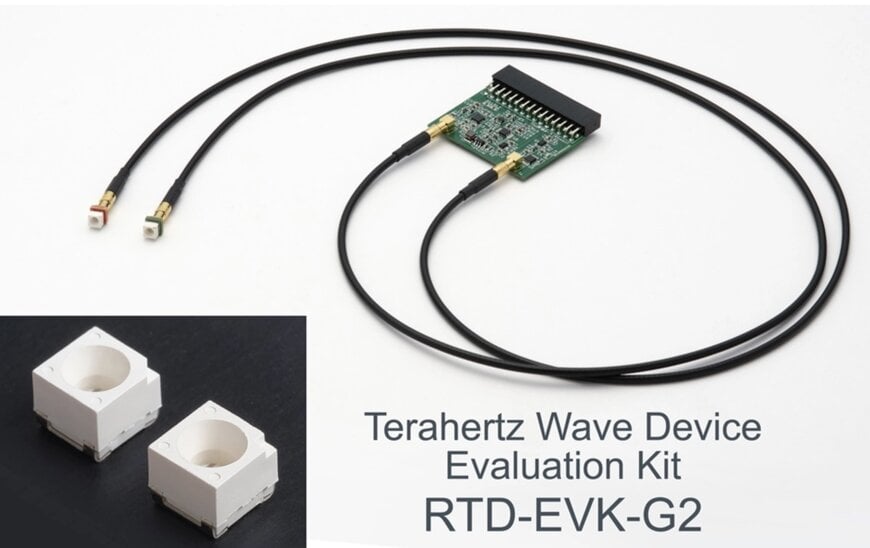
ROHM has developed a second-generation terahertz (THz) wave oscillation device based on Resonant Tunneling Diodes (RTDs), offering the technology through its RTD-EVK-G2 evaluation kit. The device is designed for non-destructive testing, medical imaging, material identification, and high-resolution radar sensing.
Joint Development and Terahertz Spectrum Characteristics
Terahertz waves occupy the frequency spectrum between radio waves and light, combining the material penetration properties of radio waves with the straight-line propagation of optical signals. Terahertz frequencies exhibit specific absorption characteristics for polymers, moisture, and other substances, making them applicable for non-destructive testing without ionizing radiation, healthcare diagnostics, and radar sensing.
Conventional terahertz systems historically required large-scale equipment and high implementation costs. Since the late 2000s, ROHM engaged in joint research with the Institute of Science Tokyo, Osaka University, and academic institutions to develop RTD-based terahertz oscillation and detection devices. In 2024, ROHM introduced first-generation sample devices aimed at reducing equipment size and implementation costs compared with conventional generation methods.
Power Output Specifications and Package Footprint
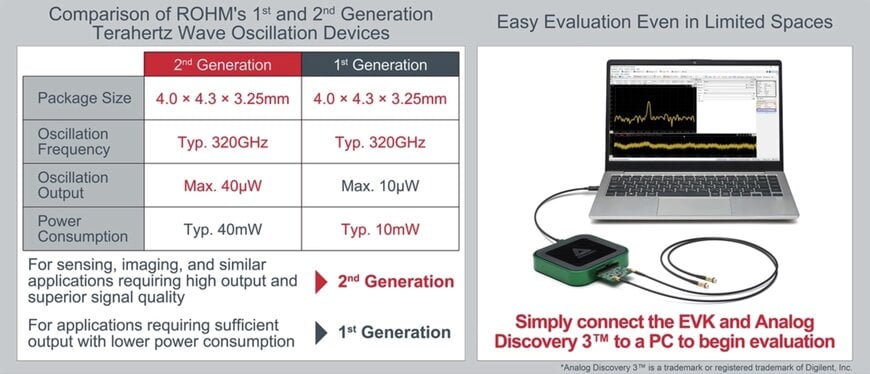
To address demand for improved signal quality in application development, the second-generation terahertz wave oscillation device increases output power to approximately four times that of the first-generation product, reaching a maximum output of 40 µW. The device maintains a 0.5 × 0.5 mm chip footprint while incorporating an updated internal semiconductor structure to support higher power output and improve signal detectability after transmission through or reflection from target objects.
The device is housed in a 4.0 × 4.3 mm PLCC package. Compared to alternative terahertz generation methods, the RTD architecture generates less heat and consumes less electrical power, enabling evaluation environments to be constructed within space-constrained settings.
Evaluation Kit Availability
ROHM is providing the second-generation oscillation device through the RTD-EVK-G2 Terahertz Wave Device Evaluation Kit. The kit includes a sample device, connection cable, and evaluation board to support THz wave oscillation and detection testing in compact development environments.
Additional Context
This section details technical specifications not included in the original news release.
Resonant Tunneling Diodes (RTDs) are ultra-high-speed semiconductor devices that utilize quantum mechanical tunneling to generate high-frequency electromagnetic oscillations up to the terahertz band at room temperature. An RTD structure consists of a thin quantum well layer sandwiched between two potential barriers formed by nanometer-scale semiconductor heterojunctions, such as indium gallium arsenide (InGaAs) and aluminum arsenide (AlAs) grown on an indium phosphide (InP) substrate.
When a DC bias voltage is applied across the diode, the energy levels of conduction-band electrons in the emitter region align with the discrete quantized energy state inside the quantum well. Under this resonance condition, electrons tunnel through the double potential barriers with high probability, generating a sharp peak in electrical current. As the bias voltage increases further, the quantized energy level drops below the emitter Fermi level, causing electron transmission to drop sharply and creating a region of negative differential resistance (NDR).
In terahertz oscillation circuits, this negative differential resistance is utilized to cancel out parasitic circuit losses and radiation resistance across integrated micro-antennas, such as slot or patch antennas. This enables sustained fundamental LC electrical resonance at sub-terahertz and terahertz frequencies. Because quantum tunneling is an ultra-fast electronic transition process occurring on sub-picosecond timescales, RTD oscillators function directly at room temperature without requiring cryogenic cooling, gas lasers, or bulky optical down-conversion systems.
Edited by Romila DSilva, Induportals Editor, with AI assistance.
www.rohm.com
