
electronics-journal.com
03
'26
Written on Modified on
PCIe 6.0 and CXL 3.1 Retimers for AI Infrastructure
Microchip Technology has introduced retimer devices designed to extend signal reach and reduce latency within high-density artificial intelligence server architectures.
www.microchip.com
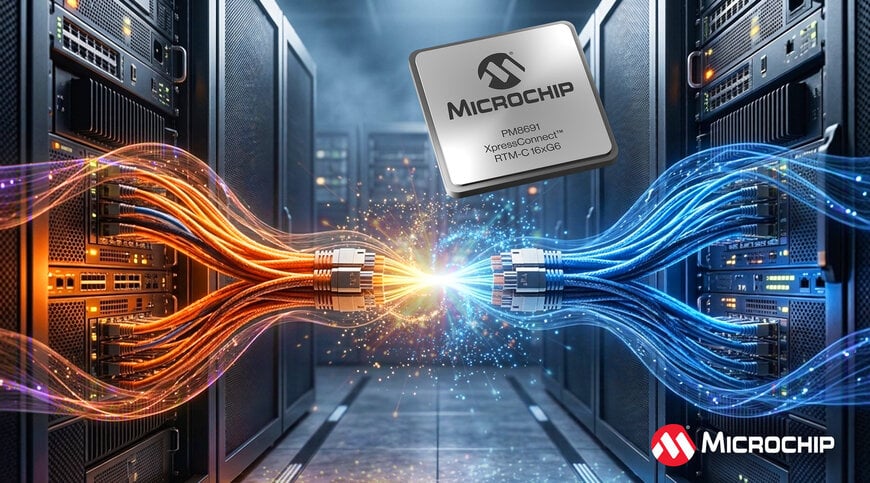
As data workloads expand, data center architects face constraints related to limited signal reach and rising latency, which can result in underutilized memory resources across large graphics processing unit clusters. These challenges intensify as interconnect speeds increase. At 64 gigatransfers per second, signal integrity limitations can restrict system scale and impact server architectures. To address these issues, low-latency retimers are being deployed to enable memory expansion and resource disaggregation within large-scale artificial intelligence fabrics.
The retimer devices extend signal reach beyond conventional PCIe Gen 5 and Gen 6 electrical limits. This allows for flexible system designs across complex baseboards, riser cards, and cabled interconnects. Designed to support higher-bandwidth connectivity, these components fit within the stringent thermal and power budgets required by modern infrastructure. The devices achieve a pin-to-pin latency of less than 12 nanoseconds, which represents an approximate 80 percent reduction compared to standard PCIe 6.0 latency specifications. This performance profile improves the utilization of accelerators and processing units by reducing data stalls in high-density clusters.
Interoperability and Diagnostic Capabilities in Server Architectures
Efficient data movement is critical as PCIe 6.0 pushes speeds to 64 gigatransfers per second, making signal reach and latency vital design challenges. The retimers serve as a high-performance connectivity hub within the server, allowing architects to build scalable, power-efficient fabrics, reclaim underutilized resources, and improve overall platform efficiency at scale.
The retimers are engineered to operate alongside existing 3-nanometer switches, SmartRAID controllers, host bus adapters, and NVMe controllers to establish a pre-validated, interoperable fabric. They integrate backward with PCIe Gen 3, Gen 4, and Gen 5 platforms to accelerate development timelines. For system monitoring, the components connect into a diagnostic ecosystem that provides a unified graphical user interface for real-time 2D eye capture and four-level pulse amplitude modulation telemetry. These capabilities allow operators to monitor link health and simplify troubleshooting to lower total cost of ownership.
Engineered as an industry-standard, drop-in solution, the devices help mitigate single-vendor dependency for hyperscale data centers. They support flexible link bifurcation configurations, including 1×16, 2×8, and 4×4 arrangements, and align with standard retimer footprint guidelines. Additional enterprise features include hot-plug support and end-to-end data integrity. For development and deployment support, diagnostic tools offer comprehensive debugging, configuration, and analysis via an intuitive graphical user interface. Connectivity is maintained through in-band PCIe or sideband signals such as UART, TWI, and EJTAG to ensure flexible monitoring.
Additional Context: Technical Specifications and Competitive Benchmarking
In the PCIe 6.0 and CXL 3.1 interconnect segment, latency and power consumption are critical performance benchmarks. Standard market solutions, such as the Astera Labs Aries or Broadcom Vantage retimer series, typically demonstrate pin-to-pin latencies ranging between 15 and 20 nanoseconds when processing PAM4 signals at 64 GT/s. The sub-12 nanosecond latency profile achieved by the Microchip architecture delivers a measurable advantage in end-to-end routing for supercomputing clusters, where minimizing response times directly impacts overall parallel processing efficiency. While interface bifurcation support up to 1×16, 2×8, and 4×4 configurations represents the current industry standard, the integration of real-time PAM4 telemetry via EJTAG and TWI interfaces offers deeper physical-layer diagnostics than baseline competitive alternatives.
Edited by Evgeny Churilov, Induportals Media - Adapted by AI.
www.microchip.com
