
electronics-journal.com
12
'26
Written on Modified on
Traction Inverters with Integrated Current Sensing
Finest integrates Melexis Hall and IMC-Hall current sensing technologies directly onto inverter control boards to optimize power delivery, maximize battery efficiency, and extend electric vehicle range.
www.melexis.com
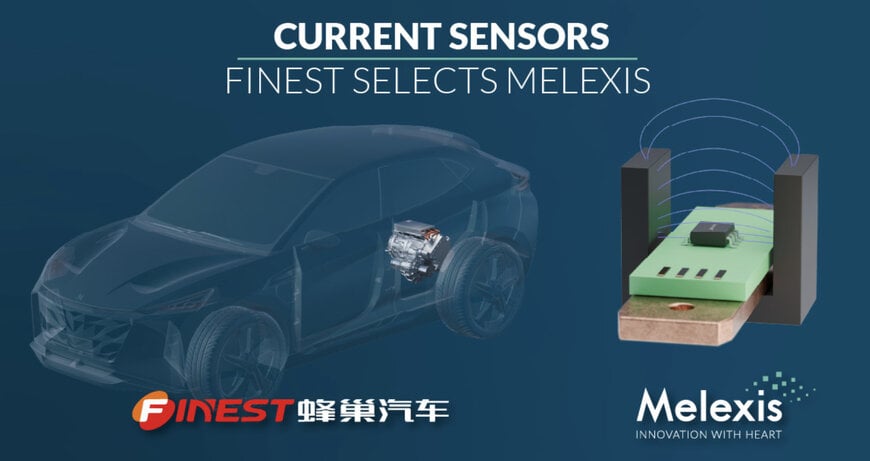
As a pioneering technical partner to global automotive OEMs, FINEST provides high-performance traction inverters that are essential for the next generation of electrified vehicles. Because inverter performance directly influences how efficiently battery power is delivered to the electric motor, accurate current sensing is fundamental to minimizing energy losses, limiting heat generation, and maintaining consistent motor control. In real-world operating conditions, these efficiency gains maximize the use of available battery energy, supporting greater driving range and helping manufacturers meet consumer expectations for everyday usability. Ensuring these components can be manufactured and deployed seamlessly at scale integrates them smoothly into the automotive industry's modern digital supply chain.
Safety, Efficiency, and Sensor Selection
As electric vehicle inverter platforms move into higher-volume production, current sensing must support more than accurate measurement alone. It must help manufacturers deliver efficient powertrain performance, stable motor control, and long-term reliability in vehicles that drivers depend on every day. For FINEST, this means selecting sensing technologies that can balance cost, footprint, and robust performance across real operating conditions, including extreme temperature variations, electrical noise, and full vehicle lifetime requirements.
Melexis' conventional Hall and IMC-Hall® technologies support this critical balance, helping FINEST maintain dependable inverter performance at scale. By contributing to efficient power delivery and reduced energy losses, these sensors ensure a consistent, responsive driving experience for end users while managing the thermal challenges inherent to high-power automotive electronics.
Board-Level Integration and Architecture Optimization
The shift from bulky, module-based current sensing to direct integration on inverter control boards is accelerating across the automotive industry, as designers look to reduce system cost, physical footprint, and overall component complexity. By integrating Melexis current sensors directly onto the PCB, inverter designers can simplify their hardware architectures while maintaining robust measurement performance in demanding operating environments.
Melexis current sensors are engineered to withstand the effects of electrical noise, thermal drift, and mechanical stress, helping designers avoid the engineering compromises often associated with more compact integration. Combined with close technical support from Melexis engineering teams, this approach enables efficient implementation and system-level optimization across high-volume inverter platforms. This seamless hardware-level telemetry provides precise, high-bandwidth data streams that ultimately feed back into the broader automotive data ecosystem for fleet-wide diagnostics and predictive powertrain analytics.
Additional Context: This section details technical specifications and competitive benchmarking not included in the original product announcement
In the highly competitive electric vehicle powertrain market, current sensing within traction inverters is achieved through three primary methodologies: shunt-based sensing, conventional core-based Hall modules, and coreless surface-mount Hall or Magnetoresistive (AMR/GMR) sensors. While shunt resistors offer high accuracy and linear performance, they introduce parasitic energy losses and generate significant thermal overhead when managing the hundreds of amperes required by modern traction motors, alongside requiring external galvanic isolation circuits. Traditional core-based Hall modules, such as those from LEM, provide isolation but are bulky, heavy, and introduce mechanical integration challenges on high-density PCBs.
Melexis’ IMC-Hall® (Integrated Magnetic Concentrator) technology directly addresses these trade-offs by combining the benefits of contactless magnetic sensing with a surface-mount footprint. Unlike standard coreless Hall sensors that require external shielding to combat the severe magnetic stray fields generated by neighboring high-voltage busbars, IMC-Hall® structures utilize an on-chip magnetic concentrator. This architecture changes the direction of the magnetic flux lines from parallel to perpendicular relative to the die, allowing the sensor to achieve a high signal-to-noise ratio and exceptional immunity to external stray fields without the weight and cost of ferromagnetic shields.
The primary engineering challenge when migrating current sensing directly onto the inverter control board lies in managing severe thermal drift and mechanical stress over an automotive operating temperature envelope spanning from -40 °C up to +150 °C. Thermal expansion and contraction of the PCB can introduce mechanical stress on surface-mount packages, leading to piezoresistive-induced offset errors in the sensor's output. Melexis mitigates this through sophisticated, on-chip digital temperature compensation algorithms and advanced stress-isolated packaging techniques. This ensures a stable magnetic sensitivity curve and minimal zero-current offset drift over the vehicle's entire lifetime, preserving the precise phase-current tracking required for space-vector pulse-width modulation (SVPWM) and dynamic motor control.
Edited by Maria Brueva, Induportals editor – adapted by AI.
www.melexis.com
