
electronics-journal.com
10
'26
Written on Modified on
Melexis Extends Triphibian® Technology to Low-Pressure Applications
New sensor variants support pressure spans as low as 2 bar, enabling robust monitoring for liquid cooling loops in high-density infrastructure.
www.melexis.com
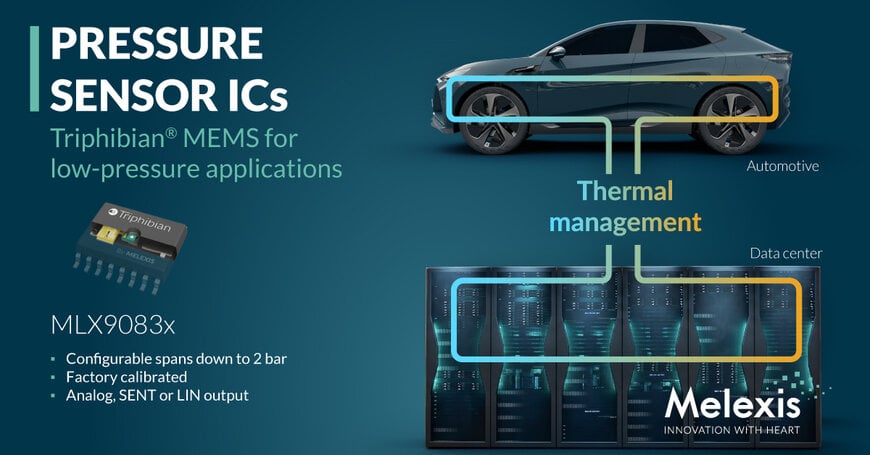
Melexis has expanded its Triphibian® pressure sensor family—including the MLX90830, MLX90833, and MLX90834 models—to support low-pressure applications. Originally designed for high-pressure environments up to 70 bar, the updated technology now enables configurable pressure spans starting at 2 bar. These sensors are uniquely engineered to measure pressure across gas, liquid, and frozen media, making them highly effective for monitoring coolant circulation in EV battery thermal management systems and liquid cooling loops for high-density AI data centers.
Integrated MEMS Architecture
The new variants utilize Melexis' proprietary suspended-cantilever MEMS sensing element, integrated with signal processing and an output driver into a single factory-calibrated SOIC16 wide-body package. This integration addresses the primary challenges of low-pressure sensing:
- Reduced Complexity: Factory calibration across multiple pressure and temperature points eliminates the need for module-level end-of-line calibration, lowering manufacturing costs.
- Flexible Integration: Manufacturers can implement the sensors as standalone modules or integrate them directly into larger assemblies, such as pumps or coolant distribution units, allowing for measurement closer to critical components.
- Media Compatibility: Enhanced glycol compatibility ensures the sensors remain accurate when in direct contact with various cooling fluids.
Technical Specifications and Robustness
The devices are developed as Safety Elements out of Context (SEooC) under ISO 26262, supporting integration into systems up to ASIL B.
The devices are developed as Safety Elements out of Context (SEooC) under ISO 26262, supporting integration into systems up to ASIL B.
- Electrical Resilience: Features protection against overvoltage (+40 V) and reverse voltage (-40 V).
- Signal Flexibility: Available in Analog, SENT, and LIN output variants. Digital versions support on-chip temperature information with the option to interface with an external NTC thermistor.
- Operational Span: The family now provides a total configurable coverage range from 2 bar to 70 bar, maintaining performance consistency across different states of matter (gas, liquid, and ice).
Additional Context: The challenge of "Triple-State" sensing
In thermal management loops, pressure sensors often fail due to the "triple-state" nature of the media. Standard ceramic or MEMS diaphragms are prone to mechanical stress if the coolant freezes (ice expansion), or they may suffer from diaphragm degradation when exposed to chemically aggressive glycol-based coolants. The Triphibian technology overcomes this by utilizing a "suspended-cantilever" structure, where the pressure-sensing element is decoupled from the housing's mechanical strain. By isolating the MEMS element, the sensor is protected from the package-level thermal expansion that typically causes "zero-point drift" in conventional sensors. This is particularly critical in AI data centers, where liquid cooling units must cycle frequently between extreme temperature states, necessitating a sensor that does not require re-calibration every time the ambient thermal environment shifts.
Edited by Lekshman Ramdas, Induportals editor – adapted by AI.
www.melexis.com
In thermal management loops, pressure sensors often fail due to the "triple-state" nature of the media. Standard ceramic or MEMS diaphragms are prone to mechanical stress if the coolant freezes (ice expansion), or they may suffer from diaphragm degradation when exposed to chemically aggressive glycol-based coolants. The Triphibian technology overcomes this by utilizing a "suspended-cantilever" structure, where the pressure-sensing element is decoupled from the housing's mechanical strain. By isolating the MEMS element, the sensor is protected from the package-level thermal expansion that typically causes "zero-point drift" in conventional sensors. This is particularly critical in AI data centers, where liquid cooling units must cycle frequently between extreme temperature states, necessitating a sensor that does not require re-calibration every time the ambient thermal environment shifts.
Edited by Lekshman Ramdas, Induportals editor – adapted by AI.
www.melexis.com
