
electronics-journal.com
17
'26
Written on Modified on
Qualcomm Launches a Platform for AI-Powered Spatial Computing
Designed for next-generation XR devices, Snapdragon Reality Elite delivers on-device GenAI, enhanced graphics performance, and extended battery life for immersive mixed reality experiences.
www.qualcomm.com

Qualcomm Technologies has launched the Snapdragon Reality Elite platform, establishing integrated machine learning processing inside the broader automotive data ecosystem and digital supply chain. This unified system architecture supplies dedicated execution blocks for high-performance video-see-through headsets and lightweight tethered glasses.
Specialized Engine Blocks within the Digital Supply Chain
The introduction of specialized computing chips alters the assembly parameters for extended reality original equipment manufacturers. This processing architecture provides dedicated silicon to operate multi-domain software applications without relying on continuous wireless data transmission to localized cloud servers. By packaging the system into a single micro-architecture, the component integrates into the global digital supply chain for consumer electronics, providing high-volume procurement pathways for spatial hardware designers.
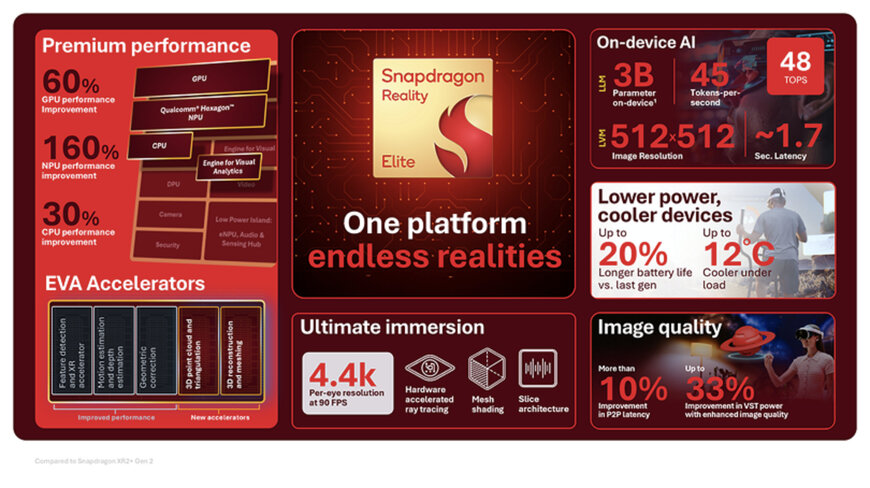
The operational baseline supports twin display outputs delivering up to 4.4K resolution per eye at a refresh rate of 90 frames per second. To stabilize high-speed pass-through video streams and reduce perception latency, the platform features a hardened silicon circuit block known as the electronic vision acceleration module. This specialized hardware component takes over raw video-see-through computing loads, ensuring uniform alignment between physical environments and digital asset projections.
Algorithmic Execution Layers and Neural Performance Scaling
The foundational advancement of the processor rests on its neural processing unit, which delivers a computation ceiling of 48 trillion operations per second. This processing density permits the microchip to store and run large language models and large vision models natively on the wearable unit.
- On-Device Neural Networks: Local computation keeps user spatial coordinates and voice commands within the local device memory, eliminating the transmission lag associated with server-dependent network requests.
- Generative Projections: The localized matrix calculations run real-time structural tasks, such as generating photorealistic avatars via Gaussian splatting and creating interactive virtual objects within a physical room.
In modern industrial operations, these native algorithms manage continuous environmental telemetry. For instance, smart enterprise glasses utilize the integrated spatial perception subsystem to register complex mechanical assemblies during maintenance routines, displaying real-time repair checklists over recognized hardware nodes. Concurrently, the neural engine runs contextual voice agents that parse immediate spoken requests from engineers on factory floors, mitigating operator cognitive strain without active internet connections.
Thermal Optimization and Ecosystem Integration Frameworks
The platform architecture achieves structural efficiency metrics to facilitate extended operational shifts. When executing identical computational workloads, the processor exhibits a 20 percent decrease in battery energy consumption alongside a reduction in operating temperature under load by up to 12 degrees Celsius. These physical operational limits enable equipment manufacturers to design thinner chassis boundaries that omit heavy mechanical cooling fans.
The underlying software environment is structurally optimized for the Android XR operating system layer, providing standardized driver layers for multi-axis hand and head tracking. Early deployment frameworks include integration within the upcoming XREAL Project Aura eyewear series alongside specialized immersive devices manufactured by Play for Dream. These hardware partnerships consolidate the underlying silicon framework as a standardized target environment for cross-platform software developers.
Additional Context:
This section details technical specifications and competitive benchmarking not included in the original product announcement
The primary architectural benchmark for the newly announced spatial computing chip rests on its performance comparisons with the previous generation Snapdragon XR2+ Gen 2 processor and competing custom spatial silicon, primarily the Apple R1 co-processor.
In raw compute scaling, the updated microchip increases neural processing unit performance by 160 percent over the Snapdragon XR2+ Gen 2, raising total capacity to 48 trillion operations per second. The previous generation architecture lacked equivalent localized capacity, rendering it heavily reliant on remote cloud processing for complex large language model inference tasks. Graphics performance scales upward by 60 percent, while central processing execution speed climbs by 30 percent, allowing the chip to process simultaneous camera streams with lower clock frequencies.
When evaluated against the Apple R1 co-processor, distinct execution strategies emerge. The Apple R1 is an input-processing chip designed to stream data from 12 cameras, five sensors, and six microphones into a separate primary M2 processor, maintaining a fixed sensor-to-display latency of 12 milliseconds. In contrast, the newly introduced architecture operates as a fully integrated single-chip system-on-chip that unifies primary general-purpose computing, graphics processing, and neural acceleration on a single die. This standalone layout reduces the physical size and power overhead required by multi-chip arrangements, enabling tethered optical-see-through glasses to operate within standard thermal limits.
Edited by Natania Lyngdoh, Induportals editor, assisted by AI.
www.qualcomm.com
Thermal Optimization and Ecosystem Integration Frameworks
The platform architecture achieves structural efficiency metrics to facilitate extended operational shifts. When executing identical computational workloads, the processor exhibits a 20 percent decrease in battery energy consumption alongside a reduction in operating temperature under load by up to 12 degrees Celsius. These physical operational limits enable equipment manufacturers to design thinner chassis boundaries that omit heavy mechanical cooling fans.
The underlying software environment is structurally optimized for the Android XR operating system layer, providing standardized driver layers for multi-axis hand and head tracking. Early deployment frameworks include integration within the upcoming XREAL Project Aura eyewear series alongside specialized immersive devices manufactured by Play for Dream. These hardware partnerships consolidate the underlying silicon framework as a standardized target environment for cross-platform software developers.
Additional Context:
This section details technical specifications and competitive benchmarking not included in the original product announcement
The primary architectural benchmark for the newly announced spatial computing chip rests on its performance comparisons with the previous generation Snapdragon XR2+ Gen 2 processor and competing custom spatial silicon, primarily the Apple R1 co-processor.
In raw compute scaling, the updated microchip increases neural processing unit performance by 160 percent over the Snapdragon XR2+ Gen 2, raising total capacity to 48 trillion operations per second. The previous generation architecture lacked equivalent localized capacity, rendering it heavily reliant on remote cloud processing for complex large language model inference tasks. Graphics performance scales upward by 60 percent, while central processing execution speed climbs by 30 percent, allowing the chip to process simultaneous camera streams with lower clock frequencies.
When evaluated against the Apple R1 co-processor, distinct execution strategies emerge. The Apple R1 is an input-processing chip designed to stream data from 12 cameras, five sensors, and six microphones into a separate primary M2 processor, maintaining a fixed sensor-to-display latency of 12 milliseconds. In contrast, the newly introduced architecture operates as a fully integrated single-chip system-on-chip that unifies primary general-purpose computing, graphics processing, and neural acceleration on a single die. This standalone layout reduces the physical size and power overhead required by multi-chip arrangements, enabling tethered optical-see-through glasses to operate within standard thermal limits.
Edited by Natania Lyngdoh, Induportals editor, assisted by AI.
www.qualcomm.com
