
electronics-journal.com
07
'26
Written on Modified on
2200 V Gallium Nitride Scales High-Voltage Power Systems
Power Integrations introduces a high-voltage semiconductor solution designed to support advanced power conversion demands in data centers and renewable infrastructure.
www.power.com
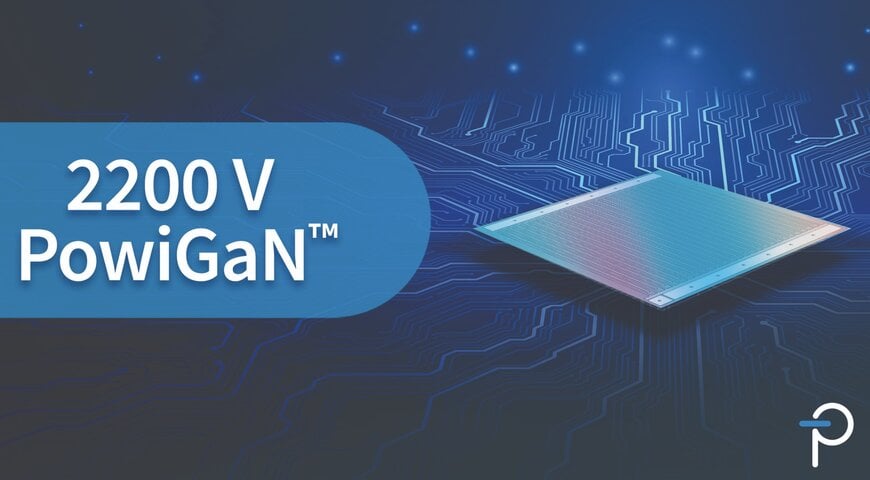
Power Integrations is releasing a 2200 V gallium-nitride (GaN) semiconductor technology, branded as PowiGaN, which enables higher switching frequencies and power density for demanding electrical systems. This hardware specifically targets high-voltage applications across artificial intelligence (AI) data centers, electric vehicles (EVs), photovoltaic systems, and high-voltage direct current (HVDC) infrastructure.
Overcoming Voltage Limitations in Power Conversion
Gallium-nitride power switches are increasingly replacing standard silicon transistors in the digital supply chain of power conversion architectures due to their higher efficiency and faster switching capabilities. Previously, the voltage ceiling of commercial GaN technology restricted its use in the main power paths of high-voltage systems. Hardware engineers designing systems for data centers, EVs, and renewables have historically relied on either lower-frequency silicon carbide (SiC) devices or complex arrays of stacked, lower-voltage GaN components. These alternative approaches require technical compromises regarding power density, overall system complexity, and long-term reliability.
The 2200 V rating provides a substantial voltage margin for emerging high-voltage power systems. This capability allows engineers to leverage the high switching frequencies of GaN to maximize power density while extending its application into voltage ranges traditionally served exclusively by SiC.
Application Capabilities for High-Voltage Infrastructure
The expansion of semiconductor voltage limits aligns with shifting industry roadmaps for an advanced automotive data ecosystem and high-voltage infrastructure. Within data center environments, 1700 V GaN integrated circuits are utilized in single-stage auxiliary power applications, while 1250 V iterations operate within the main power path of 800 VDC architectures. The 2200 V capacity allows hardware to support 1500 V distribution architectures in AI data centers, as well as EV battery and auxiliary power systems operating at elevated output voltages, such as 48V auxiliary networks.
Jennifer Lloyd, president and CEO at Power Integrations, stated that the technology provides substantial voltage margin for emerging high-voltage power systems and serves as a high-frequency alternative for solar, HVDC, and advanced industrial power conversion. Analyzing the market impact, Roy Dagher, PhD, Compound Semiconductors analyst at Yole Group, noted that the shift to 800 VDC bus architectures is altering semiconductor requirements. He observed that GaN's previous voltage limits ceded the main power path to SiC, but a 2200 V rating creates operational margin for single-stage topologies and 1500 V designs. Yole Group projects the power GaN device market will reach $3.5 billion by 2031, driven heavily by integration into these higher-voltage applications.
Additional Context
This section details technical specifications and competitive benchmarking not included in the original news release.
Standard commercial gallium-nitride (GaN) semiconductors typically operate within a breakdown voltage range of 650 V to 900 V. For systems requiring 1200 V to 3300 V, silicon carbide (SiC) has traditionally served as the accepted benchmark technology. Companies such as Wolfspeed and Infineon Technologies manufacture established 1700 V SiC MOSFETs specifically for these elevated voltage ranges.
By achieving a 2200 V rating, this GaN architecture competes directly with 1700 V SiC components. The primary objective distinction between the two technologies lies in switching frequency: GaN devices switch in the hundreds of kilohertz (kHz) to megahertz (MHz) range, whereas high-voltage SiC generally operates at lower frequencies. Higher switching frequencies directly correlate to a reduction in the physical size of passive system components, such as magnetic transformers and capacitors, thereby increasing the overall volumetric power density of the electrical architecture.
Edited by Aishwarya Mambet, Induportals Editor, with AI assistance.
www.power.com
