
electronics-journal.com
17
'26
Written on Modified on
Samsung Launches 245.76TB BM1773 SSD for High-Density AI Data Centers
E3.S QLC SSD combines PCIe 5.0, 4.5GB/s sequential writes, 50K IOPS and enhanced durability for demanding AI workloads.
semiconductor.samsung.com
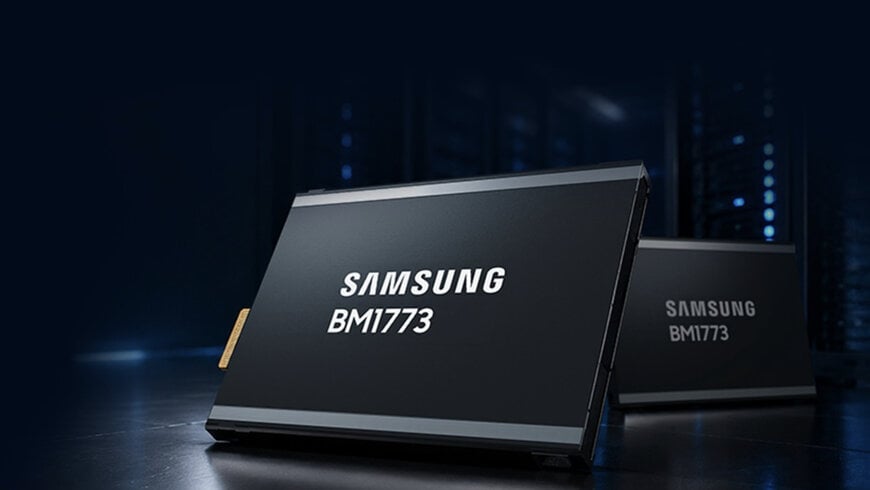
Samsung Electronics has introduced the BM1773 solid-state drive to address expanding storage capacity requirements within artificial intelligence data centers and high-performance computing facilities. The hardware serves as an ultra-high-density storage tier designed to process large context windows, multimodal datasets, and retrieval-augmented generation pipelines across modern enterprise infrastructures.
Storage Density and Server Architecture Optimization
The enterprise drive achieves a capacity of up to 245.76 terabytes within the standardized E3.S form factor, utilizing ninth-generation quad-level cell vertical flash memory with two-terabit die density. By concentrating raw capacity within individual drive bays, the storage medium consolidates rack footprint and decreases backplane cabling requirements compared to legacy hard disk drive arrays and multi-drive solid-state deployments. The reduced volume directly lowers power and cooling overhead while maintaining high volumetric density within high-density server enclosures.
Interface Bandwidth and Workload Performance
The device incorporates a sixteen-channel fifth-generation peripheral component interconnect express bus to maximize host-to-device throughput. In artificial intelligence inference workloads, the storage layer provides high-bandwidth data retrieval to house long-lived key-value cache files and large vector databases, offloading host graphics processing unit memory. The hardware delivers sequential write performance reaching 4.5 gigabytes per second and random write throughput reaching 50,000 input-output operations per second, mitigating write amplification and latency spikes during concurrent multi-tenant data indexing operations.
Hardware Reliability and Security Architecture
To resolve historical endurance limitations associated with quad-level cell architectures, the drive provides an endurance rating of 0.6 drive writes per day, representing a twofold increase in total bytes written compared to previous-generation storage products. The storage system incorporates die-level fault isolation and recovery algorithms, enabling uninterrupted read-write operation in the event of an individual flash die failure without defaulting the entire physical drive to read-only status. Cryptographic safeguards meet Commercial National Security Algorithm 2.0 standards alongside Federal Information Processing Standards validation to secure data across multi-tenant cloud environments.
Additional Context:
This section details technical specifications and competitive benchmarking not included in the original product announcement
Within the high-capacity enterprise solid-state storage sector, this architecture operates in competition with high-density quad-level cell drives including the Solidigm D5-P5336 series and the Micron 6600 ION.
A central engineering point of comparison lies in volumetric density and bus interface generation. While established enterprise drives such as the Solidigm D5-P5336 top out at 122.88 terabytes utilizing a fourth-generation peripheral component interconnect express interface, achieving 245.76 terabytes doubles available node capacity per rack unit. Furthermore, transitioning to a sixteen-channel fifth-generation architecture doubles theoretical interface bus bandwidth over fourth-generation four-lane drives, which are constrained to approximately seven gigabytes per second of raw throughput.
Regarding endurance, the 0.6 drive writes per day metric aligns with the standard 0.5 to 0.6 rating established by enterprise read-optimized quad-level cell drives such as the D5-P5336. However, at a total volume of 245.76 terabytes, an endurance rating of 0.6 drive writes per day translates into an absolute endurance threshold exceeding 260 petabytes written over a five-year service lifespan. In object caching and retrieval-augmented generation architectures, this endurance and bandwidth profile allows the solid-state tier to replace nearline hard disk drive clusters, achieving multiple orders of magnitude reduction in random read access latency at comparable rack storage capacities.
Edited by Natania Lyngdoh, Induportals editor, assisted by AI.
www.semiconductor.samsung.com
