
electronics-journal.com
25
'26
Written on Modified on
MIKROE Introduces RTLS UWB Click for Precision Location Tracking
The ultra-wideband add-on board delivers sub-decimeter accuracy for asset tracking and motion-aware indoor navigation without GPS.
www.mikroe.com
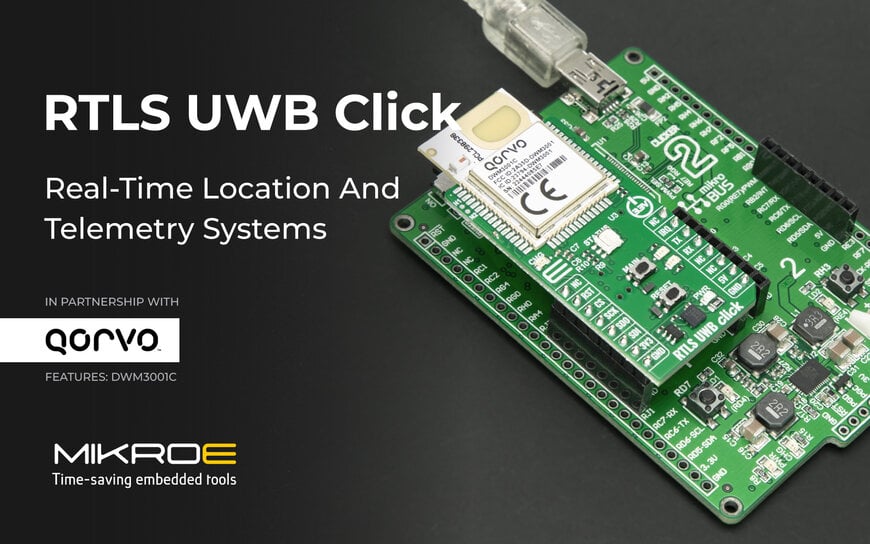
MIKROE has launched the RTLS UWB Click, a compact add-on board designed for high-precision real-time location, distance measurement, and motion-aware tracking. Developed in collaboration with Prague-based technology firm LEAPS, the board is built around Qorvo’s DWM3001C two-way ranging (TWR) communication module.
This module uniquely integrates a DW3110 ultra-wideband (UWB) transceiver, an nRF52833 Bluetooth Low Energy (BLE) System-on-Chip (SoC), and an LIS2DH12 accelerometer to create a comprehensive localization solution. According to Nebojsa Matic, CEO of MIKROE, the board delivers sub-decimeter location accuracy, making it ideal for asset tracking, automated inventory management, and indoor navigation in GPS-denied environments like hospitals, shopping malls, and airports.
The RTLS UWB Click features an integrated planar UWB antenna, power management circuitry, and robust AES 128/256 security. It supports IEEE 802.15.4-2015 and IEEE 802.15.4z BPRF standards, operating on UWB channels 5 and 9 with data rates up to 6.8 Mbps. Designed for the mikroBUS™ standard, the board includes the ClickID function for automatic host system identification, significantly streamlining the setup process. Supported by mikroSDK open-source libraries, the module allows developers to quickly integrate high-accuracy positioning into a wide range of embedded applications, saving significant design time and reducing development costs.
Additional Context
This section provides technological and market background not explicitly detailed in the original release.
Unlike traditional Bluetooth Low Energy (BLE) or Wi-Fi positioning systems that rely on Received Signal Strength Indicator (RSSI) approximations, Ultra-Wideband (UWB) uses Time of Flight (ToF) and Two-Way Ranging (TWR) methodologies to calculate distance. By transmitting short-duration radio pulses across a broad spectrum (typically over 500 MHz wide), UWB signals can penetrate obstacles and resist multipath fading or reflections in cluttered indoor environments, such as factory floors or warehouses. This enables UWB systems to achieve sub-decimeter (centimeter-level) accuracy, whereas traditional RF methods often struggle to get closer than a few meters. Furthermore, the incorporation of the IEEE 802.15.4z standard adds cryptographic security at the physical layer, preventing relay attacks that could maliciously spoof the location of high-value assets or personnel in secure industrial facilities. The onboard integration of an accelerometer allows the system to enter a low-power sleep mode when stationary and instantly wake up upon detecting motion, maximizing battery life for mobile tracking tags.
Edited by Lekshman Ramdas, Induportals editor – adapted by AI.
www.mikroe.com
