
electronics-journal.com
02
'26
Written on Modified on
Edge Processors for Consumer and Industrial Machine Intelligence
Qualcomm Technologies introduced edge processors to enable localized artificial intelligence, machine vision, and real-time deterministic control across connected consumer devices and rugged industrial deployments.
www.qualcomm.com
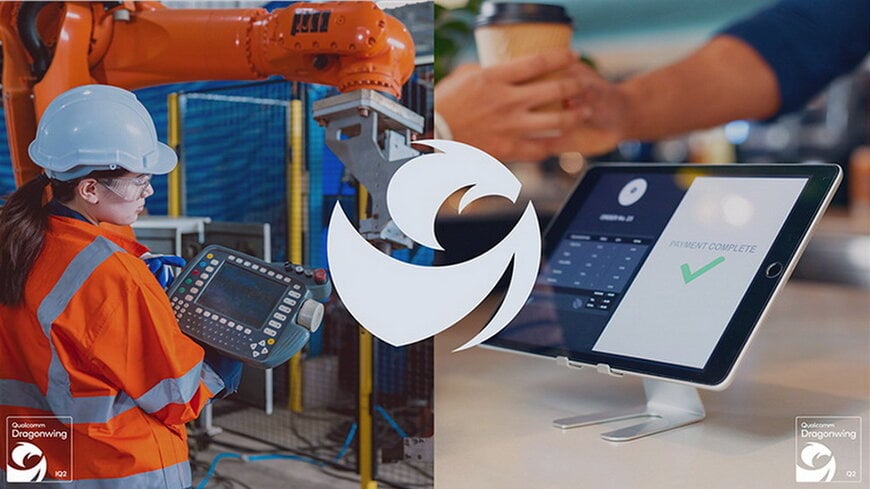
The introduction establishes dedicated silicon platforms addressing the processing requirements of intelligent edge hardware, balancing computational capacity with thermal, dimensional, and economic constraints. These platforms target operational environments ranging from commercial point-of-sale terminals and smart home equipment to industrial automation machinery and distributed utility infrastructure.
Architecture and Integrated Processing Capabilities
Local data analysis at the network edge requires heterogeneous computing structures capable of processing multiple workloads concurrently. Both the consumer-oriented and industrial platforms integrate a quad-core Kryo central processing unit, an Adreno 704 graphics processing unit, and a dedicated real-time RISC-V microcontroller unit.
System software flexibility is supported across standard operating systems, including Linux and Android, alongside the Zephyr OS real-time operating system for deterministic workloads. This heterogeneous execution environment separates critical control tasks handled by the microcontroller unit from high-level visual and user interface processing handled by the core application processors.
Target Deployments in Commercial and Edge Hardware
Edge devices deployed in commercial settings must manage multimodal inputs, user displays, and persistent cloud connectivity within integrated form factors. Integrating application computing, artificial intelligence acceleration, camera and display interfaces, LTE Cat 4 telematics, and satellite positioning into a unified platform reduces board space and component counts.
Target use cases include interactive kiosks, physical access control units, retail point-of-sale systems, robotic vacuum cleaners, agricultural sensors, and enterprise data terminals. Integration of essential communication interfaces lowers system bill-of-materials costs while supporting localized visual inspection and edge inference.
Deterministic Control and Environmental Resilience for Heavy Industry
Factory floor and field installations require deterministic networking protocols and robust operational tolerances. The dedicated industrial platform incorporates machine vision processing with dual Gigabit Ethernet ports supporting Time-Sensitive Networking, conforming to IEEE standards for synchronized, low-latency industrial communication.
The physical design provides operational stability across extended thermal boundaries ranging from -30°C to +115°C. Structural hardening mitigates operational failures caused by continuous shock and physical vibration, qualifying the platform for supervisory control systems, programmable logic controllers, industrial machine vision cameras, energy automation controllers, and oil and gas monitoring gateways.
Hardware Ecosystem and Modular Production Implementations
Original equipment manufacturers and system integrators have initiated hardware implementations across system-on-modules and single-board computers. Fibocom integrates the commercial system into its SC236 smart module, targeting industrial handhelds and portable payment solutions.
SECO has implemented the industrial processor within its Compact Vision 5 embedded vision platform and standard single-board computers, pairing the hardware with the Clea software framework for centralized fleet management. Additionally, Engicam develops specialized system-on-modules to transition existing automation lines to machine vision workflows, while Eight Development utilizes the real-time microcontroller unit for building automation, fire, and safety hardware.
Additional Context
This section details technical specifications and competitive benchmarking not included in the original product announcement.
The integration of dual Gigabit Ethernet with Time-Sensitive Networking alongside a heterogeneous quad-core core architecture directly targets industrial Internet of Things tiers currently served by the NXP Semiconductors i.MX 8M Plus and the Texas Instruments AM64x family. While Texas Instruments emphasizes dual-core Cortex-R5F real-time clusters alongside dedicated industrial communication subsystems, the combination of an Adreno 704 graphics core with LTE Cat 4 integration reduces external chip requirements for vision-centric Human-Machine Interface panels.
Similarly, the platform presents an alternative to the NXP i.MX 8M Plus, which features a dedicated neural processing unit operating at 2.3 tera-operations per second. By combining an integrated cellular modem directly on-chip with broad thermal endurance up to +115°C, the architecture avoids secondary baseband co-processors commonly required in outdoor utility telemetry and edge automation deployments.
Edited by Evgeny Churilov, Induportals Media - Adapted by AI.
www.qualcomm.com
