
electronics-journal.com
09
'26
Written on Modified on
Infineon Launches OPTIREG PMIC for EV Traction Inverters
The integrated PMIC reduces PCB footprint by up to 70% while embedding ASIL-D safety and internal resolver excitation.
www.infineon.com
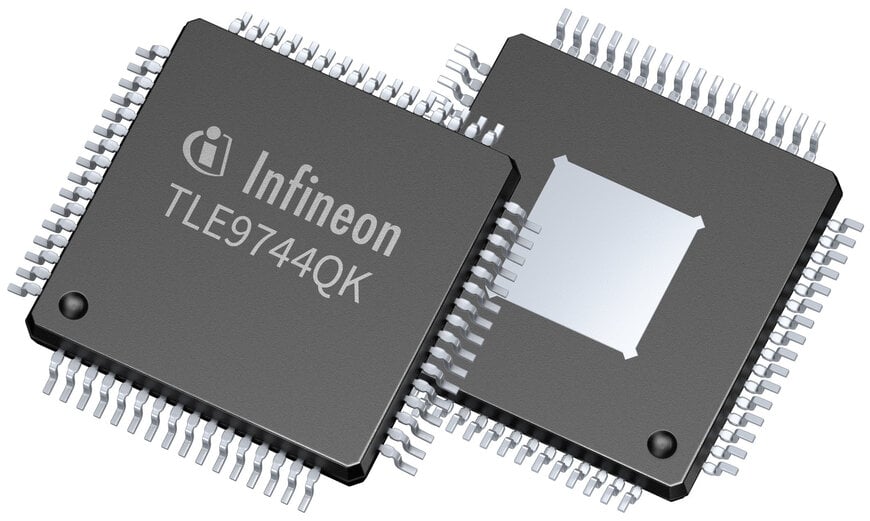
Infineon Technologies has introduced the OPTIREG™ PMIC TLE9744QK, a fully integrated power management IC engineered specifically for high-voltage traction inverters in electric and hybrid vehicles. By consolidating multiple power-supply functions, resolver excitation, and a dedicated safety engine into a single chip, the device streamlines Electronic Control Unit (ECU) architecture. This level of hardware integration replaces numerous discrete devices, lowering the overall bill of materials (BOM) and reducing the PCB footprint of replaced components by up to 70 percent.
The TLE9744QK embeds internal resolver excitation signal generation directly into the silicon, eliminating the need for external driver and monitoring circuits. To ensure rapid design cycles and broad system compatibility, the PMIC supports flexible interoperability with a wide range of microcontrollers and gate drivers without requiring major platform overhauls. It also provides dedicated off-board sensor supplies, granting engineers greater freedom during PCB layout optimization.
For mission-critical functional safety, the device integrates an Integrated Safety Logic (ISL) block that continuously monitors phase currents, DC-link voltages, and MCU operational health. Operating as an autonomous secondary safety pathway, the ISL can independently enforce a safe state if the main MCU malfunctions. A redundant supply input ensures the ISL remains fully active even during a failure of the main low-voltage rail, meeting stringent ISO 26262 ASIL-D compliance standards.
Additional Context
This section provides technological and market background not explicitly detailed in the original release.
The traction inverter serves as the core power conversion bridge in electric vehicles, transforming DC battery energy into multi-phase AC power to drive the electric motor. To control motor torque smoothly and efficiently via Field-Oriented Control (FOC), the inverter's ECU must know the precise angular position of the rotor in real time. This is typically measured using a resolver—an analog rotary transformer that requires high-frequency sinusoidal excitation signals. Conventionally, generating these excitation signals demands discrete op-amps, power transistors, and filtering networks, which consume valuable circuit board space and introduce noise vulnerabilities. As the automotive industry shifts toward compact, integrated electric drive units (e-axles combining the motor, gearbox, and inverter into a single housing), space and thermal budgets inside the ECU enclosure are constrained. Integrating resolver excitation alongside redundant ASIL-D supervisory logic into the PMIC itself significantly simplifies design complexity and shields the system from electromagnetic interference (EMI) within dense high-voltage environments.
Edited by Lekshman Ramdas, Induportals editor – adapted by AI.
www.infineon.com
