
electronics-journal.com
16
'26
Written on Modified on
Advanced 2nm Silicon Architecture Powers Mobile Machine Learning Systems
MediaTek introduced a multi-core processor platform leveraging semiconductor fabrication advances to support high-density edge intelligence and low-latency mobile graphics.
www.mediatek.com
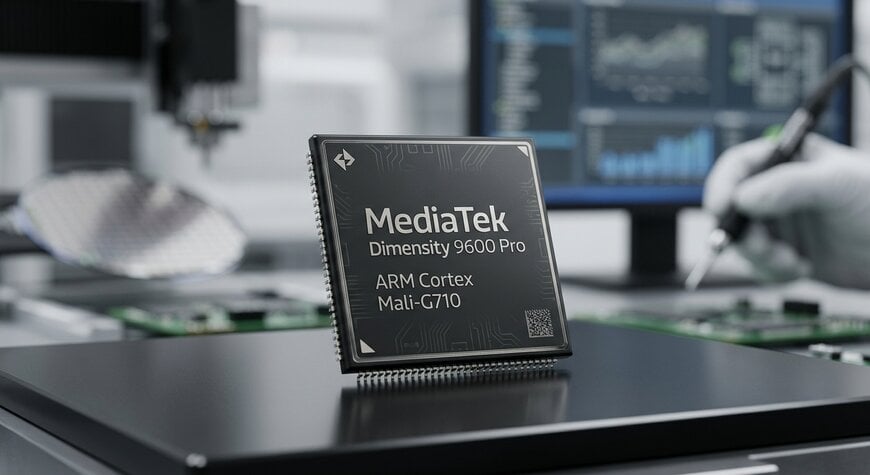
The system-on-chip transition to 2nm lithography addresses continuous computational bottlenecks within consumer electronics and mobile edge computing. MediaTek deployed this manufacturing geometry in the Dimensity 9600 Pro to combine deterministic machine learning operations with high-throughput central processing.
Heterogeneous Multi-Core Processing
System performance relies on an all-big-core architecture organized in a 2+3+3 configuration. High-intensity tasks route to two C2-Ultra cores operating at 4.55 GHz, while parallel computing divides between three C2-Pro cores at 4.35 GHz and three C2-Pro cores at 3.1 GHz. Architectural modifications yield a 17 percent increase in single-core throughput and a 15 percent improvement in multi-core throughput, accompanied by a 61 percent reduction in multi-core operational power consumption compared to prior implementations.
Coordinated Resource Allocation and Memory Bandwidth
To handle concurrent computational routines, the architecture incorporates a 34.5 megabyte system cache alongside support for LPDDR6 volatile memory and UFS 5.0 solid-state storage interfaces. Memory orchestration occurs through the Dimensity Scheduling Engine, which coordinates software layer execution with silicon resource assignment. This layout maintains application concurrency while stabilizing power draw across sustained duty cycles.
On-Device Machine Learning and Neural Processing Units
Edge artificial intelligence tasks execute across a dual-NPU matrix driven by an Agentic AI Engine. Low-power baseline monitoring runs on a dedicated secondary processor, reducing power consumption during continuous sensing states by 40 percent. Complex cognitive tasks transfer to the NPU 1090, which executes models up to 30 billion parameters, accelerating large language model prefill operations by 51 percent and improving token generation efficiency by 55 percent per watt.
Hardware-Accelerated Real-Time Rendering
Graphics rendering utilizes the G2-Ultra NX graphical processing unit, which delivers a 27 percent increase in peak computational output alongside an 18 percent acceleration in hardware ray tracing and 24 percent lower peak power consumption. The hardware pipeline achieves output frequencies reaching 185 frames per second. Workloads combine graphics processing unit resources with neural execution pipelines via the MediaTek Dimensity Neural Graphics Architecture and HyperEngine framework.
Image Signal Processing and Native Video Output
Optical data captures through the Imagiq 1290 image signal processor, integrated with the NPU via the Dimensity AI Imaging Fusion Architecture. The hardware provides up to 17 exposure values of dynamic range, real-time 60 frames per second motion tracking, cinematic 4K video recording at 120 frames per second in log profiles, and uncompressed native 4K video output at 240 frames per second. MediaTek also expanded this technology base to broader market segments through the complementary Dimensity 9600M variant.
Additional Context
This section details technical specifications and competitive benchmarking not included in the original product announcement.
The transition to sub-3nm architectures reflects standard industry trajectories, targeting Gate-All-Around field-effect transistor implementations that reduce quantum mechanical leakage current. In mobile application processors, competitive designs such as Apple A-series and Qualcomm Snapdragon 8 platforms rely on high-frequency heterogeneous clusters, utilizing single-core peak targets between 4.3 GHz and 4.6 GHz. In inference processing, standard industry benchmarks measure edge machine learning execution via peak 8-bit integer and 16-bit floating-point throughput. Competitive platforms scale neural acceleration from 45 to over 70 tera-operations per second, balancing local parameters for multimodal reasoning against strict thermal design power budgets typically capped under 15 watts during peak burst operations.
Edited by Evgeny Churilov, Induportals Media - Adapted by AI.
www.mediatek.com
