
electronics-journal.com
30
'26
Written on Modified on
Machine Vision Streaming Protocol for High-Speed Industrial Automation
Basler implements the GigE Vision 3.0 standard with RoCEv2 streaming to eliminate host CPU overhead and packet loss in high-bandwidth inspection.
www.baslerweb.com
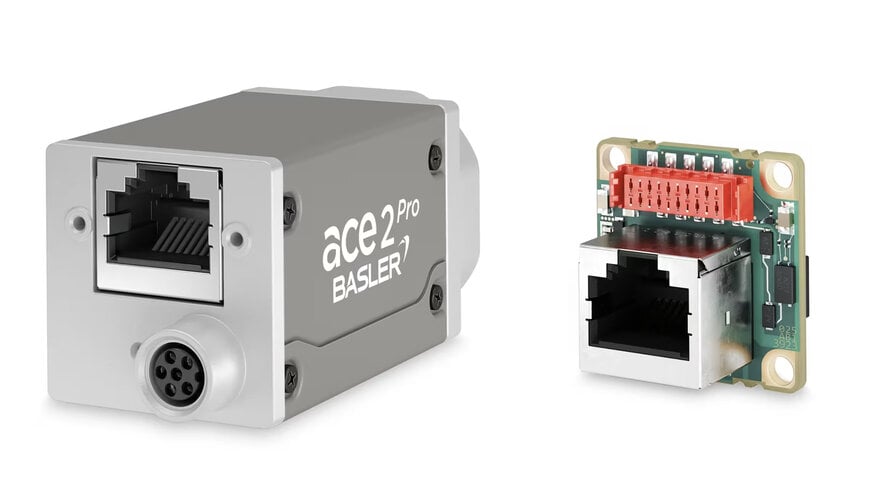
High-throughput industrial vision systems frequently encounter processing bottlenecks when multi-camera setups stream uncompressed image data, consuming substantial host CPU cycles simply to unpack network packets and manage buffer memory. In collaboration with the Association for Advancing Automation (A3) GigE Vision Technical Committee, Basler developed an integrated hardware and protocol ecosystem around GigE Vision 3.0, enabling zero-copy image transfer directly to host memory for high-speed robotics and automated optical inspection.
Zero-Copy Direct Memory Architecture via RoCEv2
Traditional GigE Vision streaming relies on the GigE Vision Streaming Protocol (GVSP), which transfers image packets over User Datagram Protocol (UDP) sockets. At high line rates, such as 10 Gigabit Ethernet (10GigE), standard network packet assembly requires host CPU core allocation to buffer, copy, and reorder incoming datagrams before image processing can begin. This processing burden increases latency and creates vulnerability to dropped packets when host system loads spike.
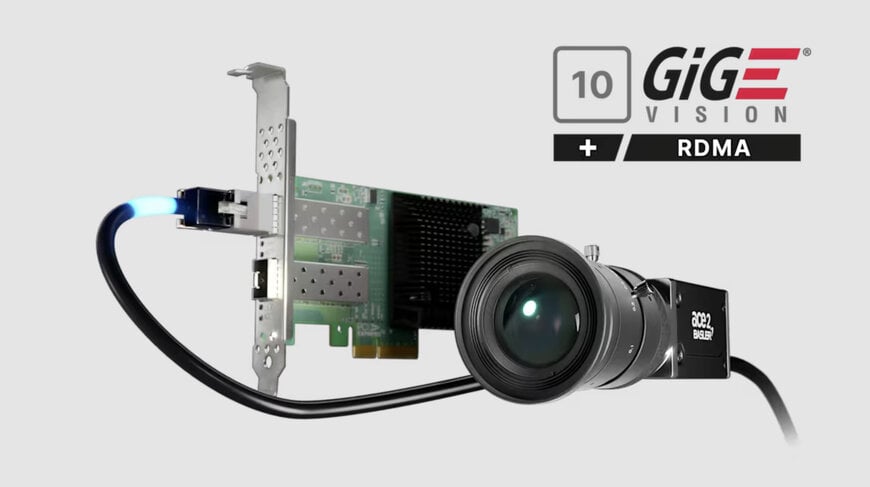
GigE Vision 3.0 introduces Remote Direct Memory Access over Converged Ethernet Version 2 (RoCEv2) as a complement to GVSP. Under this architecture, the camera establishes a direct hardware data pipeline to host RAM via an RDMA-capable Network Interface Card (RNIC). The network interface card offloads packet assembly and writes pixel data directly into target application memory addresses. Bypassing the host CPU entirely during frame ingest frees host processing resources for upstream inference, algorithmic measurement, and machine guidance tasks.
Latency Reduction and Camera Buffer Optimization
Direct memory access eliminates intermediate software caching steps on both sides of the transmission line. On the camera hardware level, the requirement for large internal volatile frame buffers is diminished because image frames stream continuously into pre-allocated memory pools without waiting for software-driven acknowledge routines.
Hardware-managed error detection and retransmission mechanisms native to RoCEv2 eliminate packet loss during line-rate operations, providing deterministic data flow. This low-latency predictability improves real-time cycle times in robotic pick-and-place operations and continuous high-speed sorting lines.
System Compatibility and Basler Implementation
GigE Vision 3.0 functions as an architectural extension of version 2.2 rather than a breaking replacement. The GigE Vision Control Protocol (GVCP) remains unchanged, preserving existing camera discovery, parameter configuration, and GenICam interface layers. Machine vision software platforms require minimal modifications to support the updated streaming transport.
Basler incorporates GigE Vision 3.0 support within a matched system architecture:
- ace 2 area-scan cameras delivering 10GigE transmission bandwidth.
- RoCEv2-compliant network interface cards (RNICs) configured for RDMA hardware acceleration.
- High-frequency machine vision lenses optimized for high-resolution industrial sensors.
- Industrial Cat6a copper cabling maintaining link signal integrity over distances up to 100 meters.
Additional Context:
This section details technical specifications and competitive benchmarking not included in the original product announcement.
In industrial machine vision interface benchmarks, GigE Vision 3.0 competes primarily against CoaXPress (CXP) and USB3 Vision interfaces. While USB3 Vision (USB 3.2 Gen 1/Gen 2) delivers raw transfer rates of 5 Gbps to 10 Gbps, its passive copper cable range is restricted to 3 to 5 meters without active repeaters, and standard USB host controller drivers incur moderate CPU utilization. CoaXPress 2.0 (CXP-12) supports raw data rates up to 12.5 Gbps per coaxial link and reaches 50 Gbps in quad-link configurations over 35 to 40 meters, but it mandates dedicated PCIe frame grabber hardware and heavy coaxial cabling topologies.
GigE Vision 3.0 with RoCEv2 bridges the gap between low-cost Ethernet topologies and dedicated frame-grabber performance. In traditional 10GigE GVSP implementations, receiving raw 10 Gbps video data streams can occupy 20 to 50 percent of an industrial multicore CPU host core to execute kernel socket processing and memory copying. By shifting data transfer to the RNIC via RDMA, host CPU consumption during line-rate 10 Gbps ingress falls below 2 percent. Furthermore, RoCEv2 operates over standard enterprise and industrial Ethernet physical infrastructure, supporting link scalability to 25G, 50G, and 100G Ethernet switches using standard fiber transceivers or Cat6a copper wiring up to 100 meters.
Edited by Natania Lyngdoh, Induportals editor, with AI assistance.
www.baslerweb.com
This section details technical specifications and competitive benchmarking not included in the original product announcement.
In industrial machine vision interface benchmarks, GigE Vision 3.0 competes primarily against CoaXPress (CXP) and USB3 Vision interfaces. While USB3 Vision (USB 3.2 Gen 1/Gen 2) delivers raw transfer rates of 5 Gbps to 10 Gbps, its passive copper cable range is restricted to 3 to 5 meters without active repeaters, and standard USB host controller drivers incur moderate CPU utilization. CoaXPress 2.0 (CXP-12) supports raw data rates up to 12.5 Gbps per coaxial link and reaches 50 Gbps in quad-link configurations over 35 to 40 meters, but it mandates dedicated PCIe frame grabber hardware and heavy coaxial cabling topologies.
GigE Vision 3.0 with RoCEv2 bridges the gap between low-cost Ethernet topologies and dedicated frame-grabber performance. In traditional 10GigE GVSP implementations, receiving raw 10 Gbps video data streams can occupy 20 to 50 percent of an industrial multicore CPU host core to execute kernel socket processing and memory copying. By shifting data transfer to the RNIC via RDMA, host CPU consumption during line-rate 10 Gbps ingress falls below 2 percent. Furthermore, RoCEv2 operates over standard enterprise and industrial Ethernet physical infrastructure, supporting link scalability to 25G, 50G, and 100G Ethernet switches using standard fiber transceivers or Cat6a copper wiring up to 100 meters.
Edited by Natania Lyngdoh, Induportals editor, with AI assistance.
www.baslerweb.com
