
electronics-journal.com
09
'26
Written on Modified on
Multi-Axis Stepper Motor Drivers Improve EtherCAT Integration
Oriental Motor Expands CVD Series with EtherCAT Multi-Axis Drivers.
www.orientalmotor.com
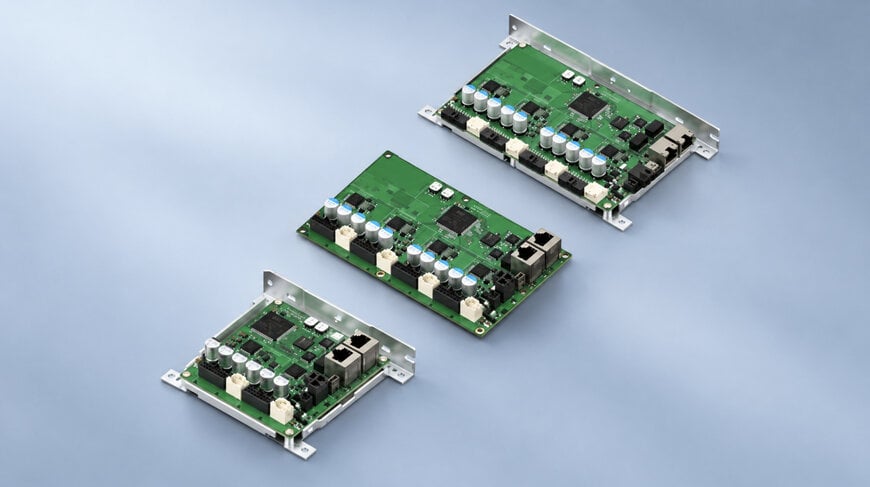
Modern multi-axis industrial machinery often encounters severe space constraints, complex wiring harnesses, and high communication overhead when integrating multiple discrete motor control units into centralized automation architectures. To resolve these spatial and signal distribution challenges in precision positioning systems, Oriental Motor U.S.A. Corp. announced an expansion of its CVD Series on October 6, 2026. The release introduces five new models designed to streamline cabinet layouts and network integration for automated industrial equipment.
Architectural Consolidation and Network Integration
The expanded CVD Series lineup incorporates four new 2-axis drivers—available with or without a mounting plate and featuring straight or right-angle connectors alongside a new 4-axis driver equipped with a mounting plate and straight connectors. By consolidating power distribution and EtherCAT communication wiring for multiple axes into a single hardware housing, the drivers eliminate the need for discrete single-axis modules.
Oriental Motor
The system operates on an EtherCAT communication protocol, which facilitates precise synchronous operation across multiple axes without requiring complex external high-speed counters. Furthermore, the architecture integrates native functions such as automatic electromagnetic brake control and direct encoder data import. Offloading these routines directly to the driver reduces host controller computational overhead and minimizes PLC program creation time.
Oriental Motor India
Motor Compatibility and Electrical Specifications
The CVD Series drivers support both 2-phase and 5-phase stepper motor technologies, allowing engineers to standardize a single control platform across diverse actuator types.
Compatible motor families include the PKP Series Bipolar 2-phase motors (4 lead wires) as well as PKP and PK Series 5-phase motors, excluding variants featuring built-in voltage-output or open-collector output encoders. The electrical specification permits input currents ranging from 0.5 to 3.0 A per axis. Total current capacities scale by model architecture, delivering a maximum of 6 A per driver for the 2-axis configurations and a maximum of 12 A per driver for the 4-axis model.
Industrial Deployment and Operational Workflows
Multi-axis positioning systems such as automated coordinate measuring machines, multi-axis semiconductor handling stages, pick-and-place mechanisms, and automated laboratory automation equipment frequently suffer from cable clutter and panel space limitations. The CVD Series addresses these mechanical design constraints through flexible connection layouts, including right-angle and straight connector orientations that accommodate tight electrical enclosures.
Integrating direct encoder data handling and automated brake management removes the requirement for separate external relay circuits and dedicated counter modules. Consequently, machine builders can decrease panel footprint dimensions, lower overall bill-of-materials costs for the host controller, and mitigate potential fault vectors associated with complex wiring harnesses.
Additional Context:
This section details technical specifications and competitive benchmarking not included in the original product announcement.
The multi-axis stepper driver market has seen a steady transition toward standardized industrial Ethernet protocols like EtherCAT to replace traditional pulse-and-direction or CANopen architectures. Industrial automation standards demand high determinism and sub-millisecond synchronization cycle times, which EtherCAT natively provides through its on-the-fly processing capability. Compared to legacy single-axis discrete drivers that require point-to-point discrete wiring and individual analog or pulse command lines, integrated multi-axis network-compatible units like the CVD Series drastically reduce copper weight, assembly labor, and susceptibility to electromagnetic interference (EMI) within industrial control cabinets. While traditional servo systems offer high closed-loop bandwidth, they frequently require complex PID tuning and mechanical gearboxes to manage low-speed resonance. In contrast, microstepping stepper drivers paired with multi-axis network integration offer a cost-effective, high-torque-at-low-speed alternative for positioning applications that do not require continuous high-velocity profiling.
Edited by Sucithra Mani, Induportals editor – adapted by AI.
www.orientalmotor.com
