
electronics-journal.com
21
'26
Written on Modified on
Scalable Trapped-Ion Quantum Computing Hardware
Infineon Technologies AG and ZuriQ AG collaborate to scale two-dimensional Penning micro-trap architectures for industrial quantum processing unit manufacturing.
www.infineon.com
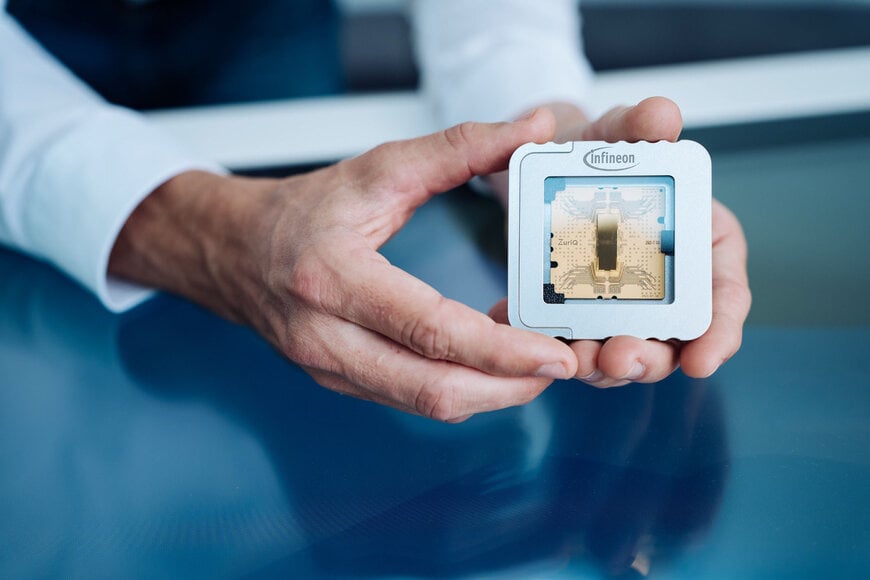
Infineon Technologies AG and ZuriQ AG have expanded their technical partnership to develop scalable quantum computing hardware for high-performance computing applications across materials science, logistics, and artificial intelligence.
Industrial Challenge and Strategic Cooperation
Scaling quantum processors requires precise individual control over increasing numbers of physical qubits without degrading coherence times. Conventional trapped-ion systems rely on one-dimensional ion chains, which encounter physical scaling limits and require complex junction switching networks to route ions.
Addressing this architecture limit demands both specialized quantum device design and high-yield semiconductor fabrication. The cooperation brings together ZuriQ’s trapped-ion design capabilities and Infineon’s established cleanroom processes, advanced packaging, and integrated photonics manufacturing infrastructure.
Technical Solution and Engineering Roles
The technical platform centers on a natively two-dimensional Penning micro-trap architecture. Unlike linear radio-frequency traps, this configuration combines static electric and magnetic fields to confine and transport ions across a planar surface. Eliminating routing junctions reduces physical complexity and allows direct scaling to larger two-dimensional qubit arrays.
ZuriQ directs the quantum micro-trap design, field geometries, and ion control schemes. Infineon provides semiconductor process development, integrating photonics directly into the substrate for optical ion manipulation and implementing advanced packaging to maintain ultra-high vacuum and low-noise operational conditions.
Demonstrated Implementation and Scaling Trajectory
Earlier validation work confirmed the viability of the joint architecture by trapping and independently controlling a 3x3 array of nine ions. This represents the largest two-dimensional array demonstrated in this trap configuration.
Phase two focuses on scaling the platform to higher qubit volumes by refining photolithographic tolerances, reducing electrode surface noise, and integrating optical delivery channels directly on-chip. These manufacturing enhancements ensure repeatable fabrication for fault-tolerant quantum computing systems.
Technical Assessments
"Advancing quantum computing toward commercial impact will require close collaboration between quantum innovators and industrial technology leaders," stated Pavel Hrmo, co-founder and CEO of ZuriQ. "Through our collaboration with Infineon, which possesses a deep understanding of process development and semiconductor technologies, we are turning ZuriQ’s technological progress into scalable, manufacturable quantum hardware."
"Progress in quantum computing requires breakthroughs in physics, but also robust manufacturing technologies capable of supporting the development of future large-scale systems," stated Clemens Rössler, Senior Director and Head of Quantum Processing Units at Infineon. "With our expertise in semiconductor manufacturing, integration and advanced packaging, we are enabling the next generation of trapped-ion quantum processing units."
Operational Impact
The two-dimensional micro-trap structure provides a direct physical path toward high-density quantum processors. Industrializing this process via standard semiconductor fabrication flows stabilizes device yields, improves thermal dissipation, and enables optical routing necessary for commercial quantum computing hardware.
Edited by Evgeny Churilov, Induportals Media - Adapted by AI.
www.infineon.com
