
electronics-journal.com
05
'26
Written on Modified on
Compact DC-DC Converter For Industrial Electronic Systems Unveiled
TDK Corporation deploys the CCG60 converter to double the available electrical power without increasing the physical footprint on industrial printed circuit boards globally.
www.tdk.com
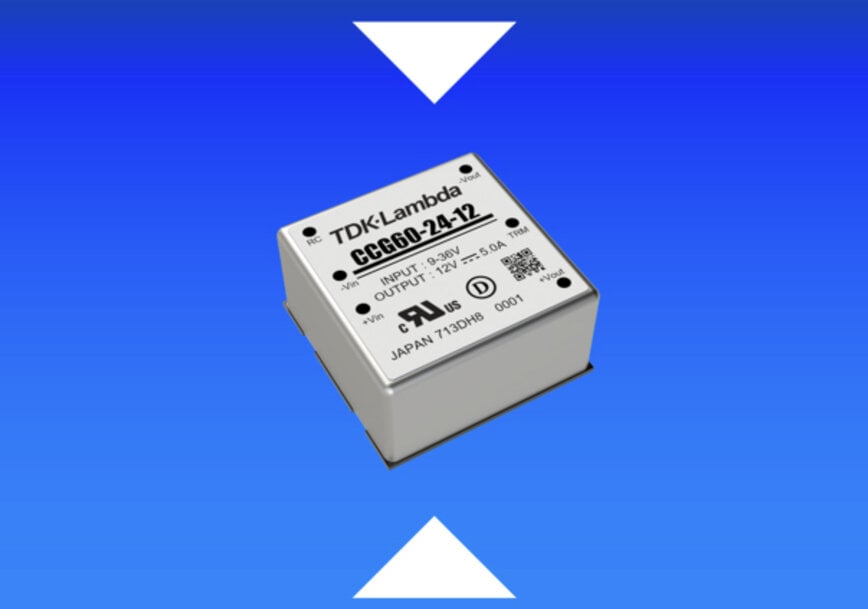
The integration of high power density components in modern electronic systems requires standardized and compact power supply solutions. To address space and thermal efficiency constraints, a new isolated DC-DC converter has been developed for test equipment, communications, and industrial automation.
Industrial Challenge And Operational Context
Industrial system designers face increasingly stringent requirements regarding equipment size reduction and thermal performance improvement. The primary technical challenge consists of supplying increased electrical power for multiple distinct loads while maintaining a minimal footprint. Insufficient power density can limit the functional capabilities of broadcasting and measurement equipment, thus requiring components capable of managing higher loads without increasing the mounting area on the board.
Technical Solution And Architecture
TDK Corporation resolves this engineering issue with the TDK-Lambda CCG60, an isolated DC-DC converter delivering up to 60 W within a format of 25.4 millimeters square, a height of 13.0 millimeters, and a weight of 30 grams. This component offers two input range options with a four to one ratio, supporting voltages from 9 to 36 Vdc for CCG60-24 models and 18 to 76 Vdc for CCG60-48 models. The module integrates a six-sided metal shielding to reduce conducted and radiated electromagnetic interference, ensuring functional isolation with a withstand voltage of 1500 Vdc between input and output.
Deployment And Integration
The converter integrates directly into existing power supply architectures while maintaining the exact same footprint as the previous CCG30 generation, allowing engineers to modernize electrical networks without modifying the physical board design. The hardware configuration supports both convection and forced air cooling, ensuring thermal stability with an efficiency reaching 93 percent. The equipment also integrates control functions such as remote on and off control, output voltage adjustment, and overcurrent protection to secure continuous operation.
Applications And Expected Results
The implementation of this hardware infrastructure, certified according to IEC, EN, UL, and CSA 62368-1 standards, ensures the compliance of industrial communication systems up to an altitude of 5000 meters. Doubling the output power within a restricted space reduces power losses and facilitates the overall thermal management of devices operating between -40 and +85 degrees Celsius. This technical standardization simplifies compliance with electromagnetic compatibility requirements, thereby reducing regulatory validation costs and times for integrators.
Edited by Maria Brueva, Induportals editor - adapted by AI.
www.emea.lambda.tdk.com
