
electronics-journal.com
22
'26
Written on Modified on
Dual-channel digital isolators raise breakdown voltage beyond 12kV
Diodes Incorporated adds reinforced isolation support, 100 Mbps signaling, and 150 kV/µs CMTI for industrial power, energy, and data centers.
www.diodes.com
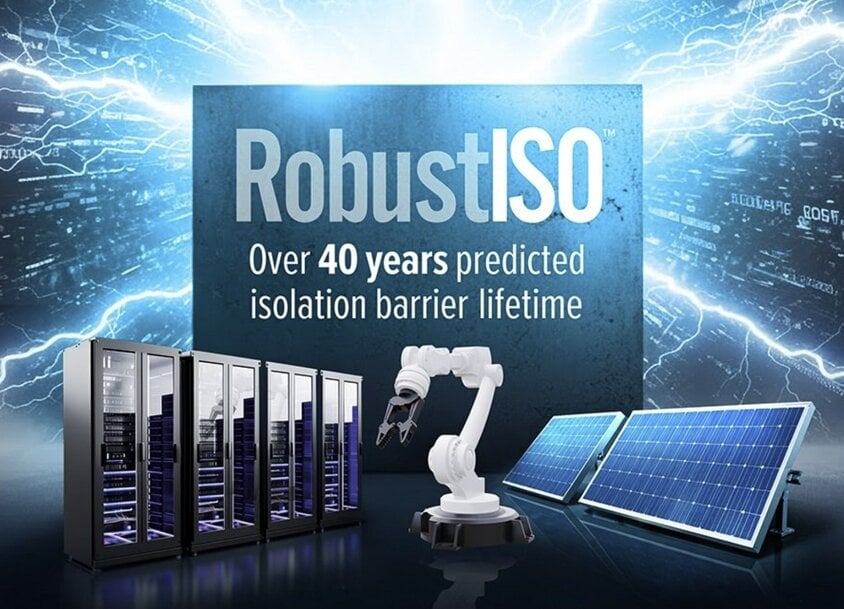
As high-voltage power electronics expand across industrial automation, renewable energy conversion, and data center power supplies, digital interfaces increasingly require reinforced isolation and high immunity to electrical noise. Diodes Incorporated has introduced the API772x RobustISO™ series of dual-channel digital isolators for isolated digital signal transmission in these environments.
Isolation performance targeted at high-voltage equipment
The API772x series is designed to meet reinforced and basic isolation requirements across multiple certification frameworks, including VDE, UL, and CQC. For insulation verification, the devices are specified for 5,000 VRMS for one minute in line with UL 1577, along with an 8,000 VPK isolation rating aligned to DIN EN IEC 60747-17 (VDE 0884-17). The parts are also specified with a maximum surge isolation voltage of 12,800 VPK.
Diodes positions the series as exceeding a 12 kV breakdown voltage, contrasted against comparable products described as operating at less than 10 kV.
Capacitive barrier design and lifetime assumptions
The isolators use a capacitive isolation barrier with a thickness greater than 25 µm. Based on the barrier design and signaling method, Diodes projects an operational lifetime of over 40 years.
Data transfer across the isolation barrier uses an ON–OFF keying (OOK) modulation scheme, which supports digital communication through the capacitive structure while maintaining the rated isolation characteristics.
Noise resilience for fast-switching power systems
Switching power stages in inverters, motor drives, and high-density power supplies can generate steep common-mode transients that corrupt digital signals and increase error rates. The API772x series is specified with a minimum common-mode transient immunity (CMTI) of 150 kV/µs, positioning it for electrically noisy environments where signal integrity and EMI control are critical.
The combination of high CMTI and the vendor’s stated low emissions profile is intended to support more reliable digital communications across isolated boundaries, particularly in installations subject to high dv/dt events.
Data rate, supply range, and timing specifications
The devices support data rates up to 100 Mbps, enabling compatibility with a range of digital transmission protocols used in power and control electronics. They operate across a 2.5 V to 5.5 V supply voltage range and are specified for low current consumption, typically 2.1 mA per channel at 1 Mbps.
For timing-sensitive digital interfaces, the API772x series lists a typical propagation delay of 11 ns, supporting fast control loops and gate-drive adjacent signaling where deterministic latency matters.
Channel direction options and default output behavior
The API772x family includes variants that change channel direction configuration and default output state, allowing designers to match device behavior to system safety requirements.
The API7720 is configured with both channels in the same direction, while API7721 and API7722 feature opposite-direction channel configurations. For default output levels, devices with the “F” suffix default to a low output state, while versions without the suffix default to high, enabling fail-state selection aligned with application needs.
Where dual-channel isolators fit in industrial power architectures
Dual-channel digital isolators are commonly used to protect low-voltage control logic from high-voltage domains in systems such as motor drives, on-board and off-board chargers, PV inverters, and power conversion stages in data centers. With reinforced/basic isolation support, high surge withstand ratings, and high CMTI, the API772x series is positioned for designs that must maintain signal integrity under high-voltage stress while meeting certification-driven insulation requirements.
www.diodes.com
