
electronics-journal.com
30
'26
Written on Modified on
Microchip Technology expands its MCU portfolio
These 5V-capable microcontrollers deliver high performance for industrial and consumer applications while maintaining low system complexity and costs.
www.microchip.com
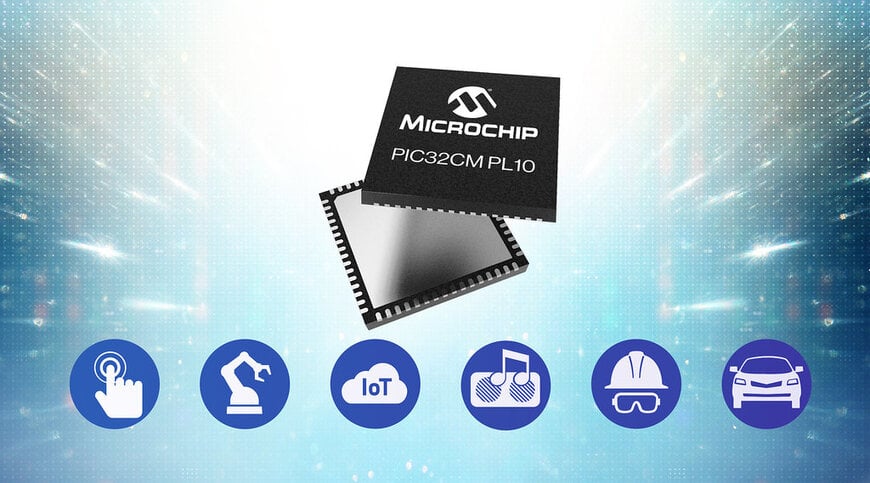
Microchip Technology has introduced the PIC32CM PL10 family of 32-bit microcontrollers (MCUs) based on an Arm Cortex-M0+ core, designed to combine robust performance with 5 V-tolerant operation and rich peripheral integration for embedded applications such as industrial control, building automation and consumer interfaces.
New 32-Bit MCU Options with Enhanced Peripheral Integration
The PIC32CM PL10 MCUs extend Microchip’s existing portfolio of Arm Cortex-M0+ devices with a focus on balancing low-power operation and system simplicity for high-volume designs. Key differentiators include built-in Core Independent Peripherals (CIPs) that offload repetitive and deterministic tasks from the CPU to enhance real-time responsiveness and efficiency, as well as integrated capacitive touch capabilities and a 12-bit analog-to-digital converter (ADC) providing improved noise immunity for analog signal measurement.
Operating across a broad supply voltage range (1.8 V to 5.5 V) enables 5 V-tolerant designs required in many industrial, automotive and consumer systems without external level shifters, supported by Multi-Voltage I/O (MVIO) on-chip. Support for the Cortex Microcontroller Software Interface Standard (CMSIS) means modular code portability across development environments is possible, aiding software reuse and developer productivity.
Relevance for Embedded Control and Human-Machine Interfaces
The PIC32CM PL10 family targets multiple application domains where mixed analog/digital integration and interface flexibility are essential. In human-machine interface (HMI) designs, the integrated Peripheral Touch Controller (PTC) supports up to 29 self-capacitance channels for capacitive touch control without external components, enabling responsive user interaction while conserving board space. In industrial automation and sensor-based systems, the combination of 5 V operation and robust analog interfaces supports direct interfacing to common sensors and legacy systems.
Pin-to-pin compatibility with many existing 5 V architectures, including those based on 8-bit microcontrollers, facilitates migration to 32-bit processing without extensive hardware redesign. This can reduce development risk in projects that require higher computational performance while maintaining continuity with established peripheral ecosystems.
Development Tools and Ecosystem Support
Microchip supports the PIC32CM PL10 family through its MPLAB development ecosystem, with compatibility across industry-standard development tools such as Visual Studio Code, IAR Systems, Arm Keil and SEGGER, as well as support for open-source platforms including Zephyr. AI-based coding assistants are available to streamline development workflows and provide code suggestions tailored to specific project requirements.
Functional safety considerations are addressed through compliance with standards such as ISO 26262, relevant for automotive and safety-critical systems, and documentation and libraries supporting safety-oriented design are available to engineers.
Competitive Context
While many low-cost microcontrollers in the embedded market support 5 V operation and basic peripheral sets, the PIC32CM PL10 family differentiates itself through its combination of Cortex-M0+ processing, robust analog front ends, extensive CIP offload capabilities and broad ecosystem support. Objective benchmarks for such devices generally revolve around peripheral integration, noise immunity in industrial environments and ease of migration from legacy 8-bit platforms; the PIC32CM PL10’s feature set aligns with these criteria for embedded control and interface applications.
www.microchip.com
