
High-side ideal diode controller for automotive applications with reverse polarity protection
Toshiba Electronics Europe presents a compact high-side ideal diode controller for protected and redundant automotive power architecture.
www.global.toshiba
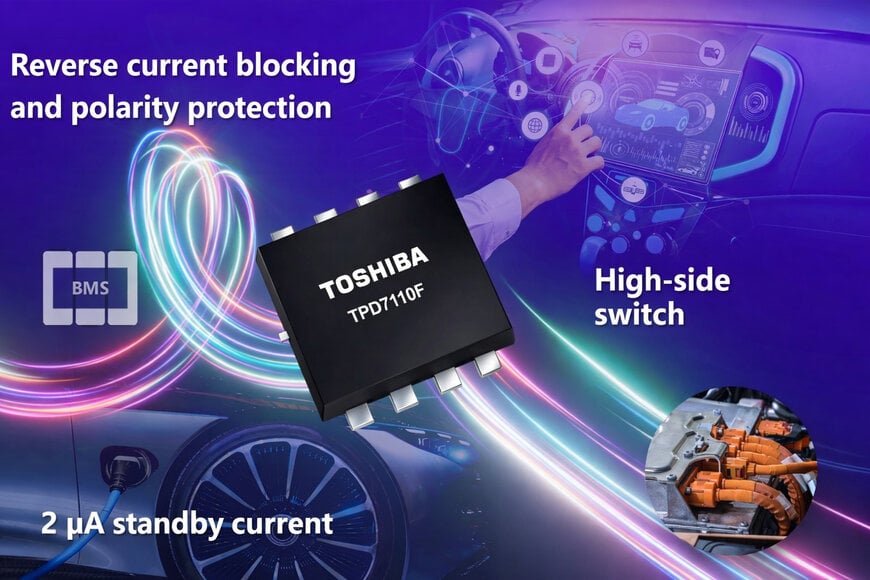
Toshiba Electronics Europe GmbH has introduced the TPD7110F, a high-side ideal diode controller designed to ensure safe power path control in automotive systems such as BCM, BMS and head-up displays, with integrated reverse polarity protection and reverse current blocking.
Power path control in redundant automotive systems
Automotive electronic architectures increasingly require redundant power supply lines to meet functional safety requirements and improve system availability. In this context, ideal diode controllers are used to manage multiple supply lines while reducing conduction losses compared to solutions based on discrete diodes.
The TPD7110F is intended for applications such as body control modules (BCM), battery management systems (BMS) and windshield head-up displays (HUD), where controlled switching and fault isolation are required. The device integrates reverse polarity protection to prevent damage caused by incorrect battery connections, a condition that may occur during maintenance or replacement operations.
The combination of reverse polarity protection and reverse current blocking enables the implementation of redundant power supply configurations in automotive distribution networks.
Ideal diode architecture with external MOSFET
The device drives an external N-channel MOSFET via an integrated charge pump with an internal capacitor, achieving low-loss ideal diode behavior on the high side of the power supply line.
Monitoring the MOSFET drain-source voltage (VDS) allows reverse current conditions to be detected. When an inverse voltage difference is identified, the controller interrupts the current flow from the load back to the battery, preventing unwanted discharge paths and improving fault containment.
In systems that require bidirectional current flow, for example to allow energy storage in the battery, the reverse current blocking function can be disabled.
By pairing the device with back-to-back connected MOSFETs, it is also possible to implement an electronically controlled ON/OFF load switch, increasing flexibility in automotive power distribution design.
Reduced footprint for high-density PCB layouts
The TPD7110F is available in Toshiba’s PS-8 package with dimensions of 2.9 mm × 2.8 mm. According to the company, this solution reduces the mounting area by approximately 50% compared to conventional MSOP-8 packages.
Integration of the charge pump capacitor eliminates the need for additional external components, reducing the total component count and enabling high-density PCB layouts. This is particularly relevant in modules such as BCM and HUD, where board space is limited.
Low quiescent current for energy management
Current consumption is a critical parameter in automotive electronic control units, especially in systems that are permanently connected to the battery. The controller features a typical operating current of 100 µA and a typical standby current of 2 µA. These values contribute to the vehicle’s overall energy balance and reduce parasitic drain when the vehicle is turned off.
Positioning in automotive power architectures
Compared to OR-ing solutions based on Schottky diodes, ideal diode controllers with an external MOSFET reduce forward voltage drop and associated power dissipation, particularly at high load currents. This results in improved thermal performance and higher efficiency in 12 V and 24 V automotive systems.
By integrating reverse polarity protection, reverse current detection through VDS monitoring and a compact package, the TPD7110F meets the typical requirements of redundant automotive power architectures while maintaining low quiescent current.
According to Toshiba Electronics Europe GmbH, the device is intended to support the development of compact, low-loss and highly reliable power supply subsystems for next-generation mobility platforms.
www.toshiba.com
