
electronics-journal.com
03
'26
Written on Modified on
Dual MOSFET Integration for Compact Motor Control
Toshiba introduces a complementary MOSFET architecture that reduces component count and supports efficient power switching in industrial and consumer electronics.
www.global.toshiba
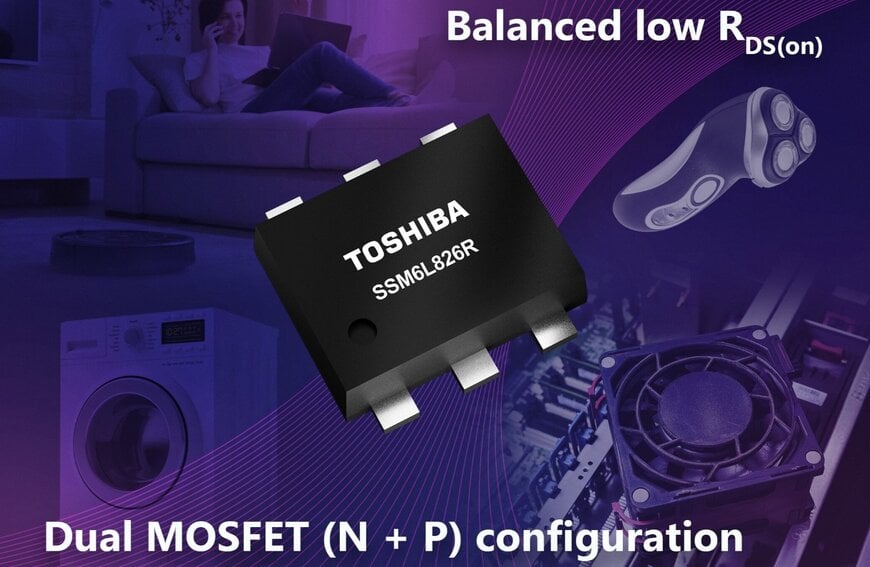
Toshiba Electronics Europe GmbH has introduced a new dual MOSFET device that integrates N-channel and P-channel transistors within a single package. Designed for motor control and power-switching applications, the component targets space-constrained consumer and industrial equipment where circuit simplification, energy efficiency, and component reduction are increasingly important design requirements.
Complementary MOSFET Design for Power Management Circuits
Power electronics designers frequently use combinations of N-channel and P-channel MOSFETs in motor drives, load switches, and power distribution circuits. Integrating both transistor types into a single package can reduce printed circuit board (PCB) area, simplify component sourcing, and decrease assembly complexity.
The newly introduced device combines one N-channel MOSFET and one P-channel MOSFET in a compact TSOP6F package measuring 2.9 mm × 2.8 mm × 0.8 mm. The package uses flat-pin construction to support automated assembly and high-density PCB layouts.
Target applications include brushless DC (BLDC) single-phase motor control, brushed DC motor control, and load-switching functions in consumer electronics, industrial controllers, and power supply systems.
Low and Balanced On-State Resistance
The MOSFET employs Toshiba's UMOSVIIH process technology for the N-channel transistor and UMOSVI process technology for the P-channel transistor.
A key characteristic of the device is the close matching of on-state drain-source resistance values. The N-channel MOSFET achieves a maximum RDS(ON) of 46 mΩ at a gate-source voltage of 10 V, while the P-channel MOSFET achieves a maximum RDS(ON) of 45 mΩ at a gate-source voltage of −10 V.
The nearly identical resistance values help maintain balanced conduction losses between the two transistors. In complementary switching circuits, significant resistance differences can create uneven thermal behavior and increase design complexity. Matching resistance characteristics can therefore simplify circuit optimization and thermal management.
PCB Space Reduction and Component Consolidation
Combining complementary MOSFETs within a single package provides advantages beyond electrical performance. By replacing two discrete devices with a single component, designers can reduce PCB footprint requirements and lower the total number of components in a design.
This approach can also contribute to a lower bill of materials (BOM) cost and simplify inventory management. Such benefits are particularly relevant in compact consumer devices and industrial control systems where board space is limited and manufacturing efficiency is a priority.
Applications in Motor Control Systems
Motor control represents one of the primary application areas for complementary MOSFET configurations. In BLDC motor drives and brushed motor systems, MOSFETs are used to switch current efficiently while minimizing power dissipation.
Lower conduction losses can improve overall system efficiency and reduce heat generation, which is especially important in enclosed electronic equipment. The balanced electrical characteristics of the integrated MOSFET pair can also support more predictable switching performance in motor-control topologies.
In power-supply load-switching applications, the device can be used to control power distribution paths while minimizing voltage drop across the switching stage.
Expansion of Dual MOSFET Portfolio
The launch expands Toshiba's TSOP6F dual MOSFET portfolio, which includes multiple device configurations designed for different power management requirements. The range consists of three dual N-channel MOSFET products, one dual P-channel MOSFET product, and two complementary N-channel/P-channel MOSFET devices.
This broader selection allows engineers to choose device combinations based on specific voltage, current, efficiency, and layout requirements without changing package format.
Semiconductor Miniaturization and Efficiency Trends
Demand for higher power efficiency and smaller electronic systems continues to influence semiconductor development across industrial automation and consumer electronics sectors. MOSFET integration strategies that combine multiple switching elements into a single package are increasingly used to support compact system design while reducing power losses.
By integrating complementary MOSFET technologies within a small-footprint package and maintaining closely matched resistance characteristics, the device addresses both miniaturization and efficiency requirements in modern electronic equipment.
Additional Context
This section details technical specifications and competitive benchmarking not included in the original news release.
Complementary MOSFET devices are widely available from semiconductor manufacturers including Infineon Technologies, Nexperia, onsemi, ROHM Semiconductor, and Vishay Intertechnology
With a 30 V drain-source voltage rating and maximum on-state resistance values of approximately 45–46 mΩ, the device is positioned within the low-voltage MOSFET category commonly used in motor-control and load-switching applications. Comparable products in TSOP-6, SOT-23-6, and DFN package formats generally target voltage ranges between 20 V and 40 V and prioritize low conduction losses for battery-powered and industrial electronics.
The integration of complementary MOSFETs into a single package represents an established design approach for reducing PCB area. However, closely matched N-channel and P-channel resistance values remain an important differentiator because they help simplify circuit balancing and thermal design. As electronic equipment continues to become smaller and more power-efficient, integrated MOSFET solutions are increasingly used in compact motor drives, portable devices, industrial sensors, and embedded power-management systems.
Edited by Aishwarya Mambet, Induportals Editor, with AI assistance.
www.toshiba.com
