
electronics-journal.com
01
'26
Written on Modified on
Code-Free Three-Phase Motor Driver Simplifies BLDC Design
Melexis introduces MLX80339 to enable fast deployment of efficient, low-noise fan systems without embedded software development.
www.melexis.com
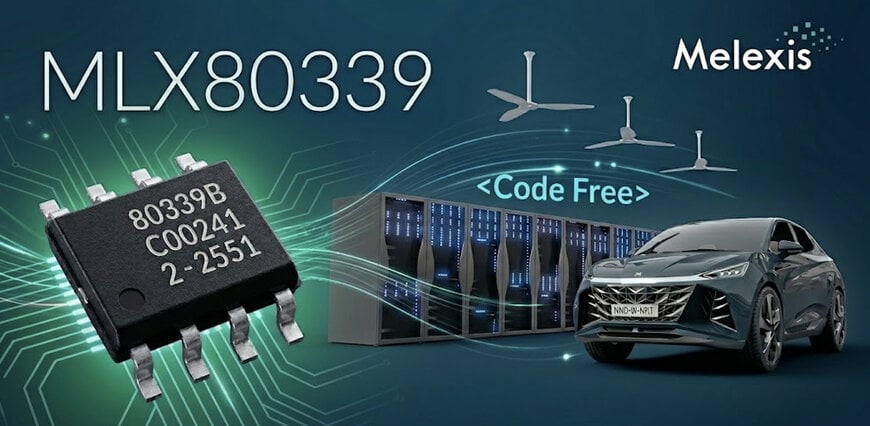
Melexis has released a three-phase motor driver IC designed to simplify brushless DC (BLDC) fan development. The device integrates pre-validated control logic and a code-free configuration approach, enabling rapid prototyping and deployment across consumer, industrial, and automotive applications.
Bridging performance and integration complexity
Designers of compact motor systems face increasing requirements for higher efficiency, reduced acoustic noise, and improved reliability while maintaining cost constraints. Traditional single-coil motor drivers offer simplicity and low cost but often compromise on performance metrics such as noise and efficiency.
Three-phase motor control architectures address these limitations by delivering smoother torque and improved energy efficiency. However, their adoption has been limited by integration complexity, longer development cycles, and the need for embedded software expertise. The MLX80339 addresses this gap by embedding motor control logic directly within the IC, eliminating the need for firmware development while preserving three-phase performance advantages.
Code-free configuration and rapid prototyping
The device is supported by a configuration ecosystem that replaces manual motor tuning with parameter-based setup. Using a dedicated Start-to-Run tool and evaluation hardware, developers can generate operational configurations in under 15 minutes.
This workflow leverages pre-characterized motor behavior models, allowing engineers to bypass tasks such as algorithm development, commutation tuning, and startup optimization. As a result, development effort shifts toward system-level validation rather than low-level control implementation.
This approach aligns with broader trends in the digital supply chain, where pre-validated building blocks reduce engineering overhead and accelerate time to market.
Electrical performance and protection features
The motor driver supports sensorless operation with power capabilities up to 20 W at 12 V and 40 W at 24 V. It provides a configurable current limit up to 3 A and integrates multiple protection mechanisms, including undervoltage, overvoltage, overcurrent, and thermal shutdown.
A wide operating voltage range of 6 V to 26 V and temperature support from −40 °C to 125 °C (with junction temperatures up to 150 °C) enable deployment in demanding environments. These characteristics are particularly relevant for automotive and industrial use cases where thermal and electrical robustness are critical.
Interface flexibility and system compatibility
The IC supports both legacy and advanced control schemes. Pulse-width modulation (PWM) input enables straightforward replacement of existing fan driver designs, while digital interfaces such as UART and I²C allow enhanced diagnostics, monitoring, and multi-device coordination.
This dual-mode capability enables designers to scale system complexity based on application requirements without redesigning the core hardware architecture.
Application scope and use cases
The compact SO8-EP package is optimized for space-constrained applications, including cooling fans, ceiling fans, and automotive seat ventilation systems. Beyond fan applications, the driver is suitable for small motors, pumps, and actuators requiring efficient and low-noise operation.
By reducing design complexity, the solution also enables adoption in lower-volume and cost-sensitive projects where three-phase motor control was previously impractical.
Positioning within motor control technologies
Compared with conventional three-phase motor driver solutions requiring firmware development, the code-free architecture provides a measurable reduction in development time and required expertise. At the same time, it retains the efficiency and acoustic benefits associated with multi-phase motor control.
This positions the device as an intermediate solution between basic single-phase drivers and fully programmable motor control platforms, expanding access to advanced motor control capabilities across a wider range of applications.
Edited by an industrial journalist Sucithra Mani with AI assistance.
www.melexis.com
