
electronics-journal.com
28
'26
Written on Modified on
Toshiba Samples Integrated Motor Control Device for Automotive
New SmartMCD component combines MCU, gate driver, and sensorless FOC to support compact, efficient BLDC motor control in electrified vehicle systems.
www.global.toshiba
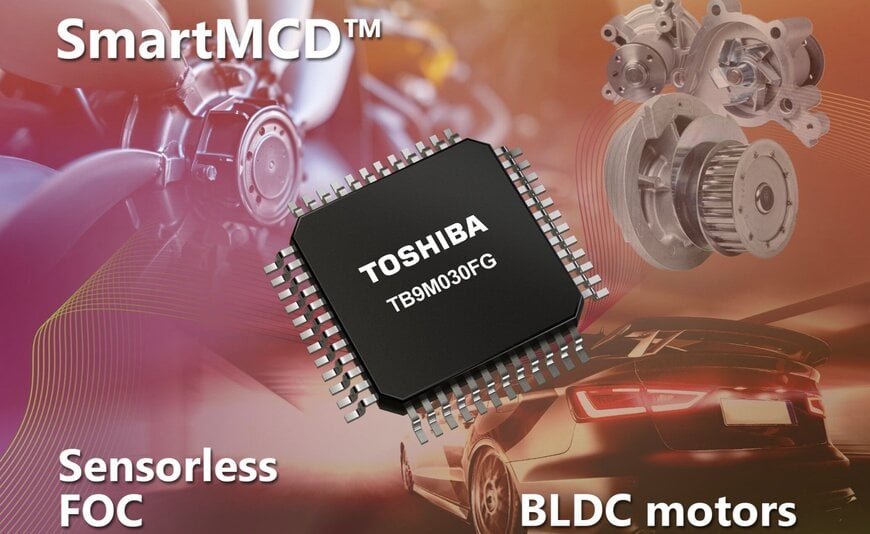
Electrified automotive subsystems increasingly rely on compact, efficient motor control architectures to manage pumps, fans, and auxiliary drives. In this context, Toshiba Electronics Europe GmbH has begun technical sampling of the TB9M030FG, a SmartMCD device integrating a microcontroller and gate driver for three-phase BLDC motor control.
Integration targets ECU consolidation and board reduction
The TB9M030FG addresses the growing requirement to reduce electronic control unit (ECU) complexity and board footprint in vehicle systems. By combining a 32-bit microcontroller, gate driver circuitry, LIN transceiver, and power supply functions into a single package, the device reduces component count and simplifies system design.
The component is qualified to AEC-Q100 standards and is housed in a compact 9 mm × 9 mm QFP48 package, supporting space-constrained automotive designs such as electric water pumps, oil pumps, cooling fans, and HVAC blowers.
Embedded processing and motor drive architecture
At its core, the device integrates an Arm® Cortex®-M0-based microcontroller with 64 KB flash memory, 12 KB ROM, and 4 KB RAM. The integrated gate driver controls external N-channel power MOSFETs to operate three-phase BLDC motors.
The inclusion of a LIN interface enables communication within automotive networks, while the integrated power supply supports direct operation from vehicle battery systems. This architecture supports deployment in distributed automotive control nodes within a broader automotive data ecosystem.
Sensorless FOC for low-speed motor control
The device is designed for sensorless field-oriented control (FOC), particularly in low-speed operating conditions where rotor position detection is typically challenging. Accurate control at startup and low speeds is essential for applications requiring stable torque delivery and reduced acoustic noise.
Toshiba integrates a Vector Engine coprocessor to accelerate FOC calculations, enabling shorter control cycles while reducing CPU load and software complexity. This allows more efficient execution of motor control algorithms within constrained embedded environments.
Alternative approach to rotor position estimation
The TB9M030FG supports sensorless vector control using motor magnetic anisotropy (Ld ≠ Lq) in permanent magnet synchronous motors, including three-phase BLDC configurations. This method generates reluctance torque based on differences in magnetic properties within the rotor.
Unlike high-frequency injection techniques that superimpose signals to estimate rotor position, this approach avoids harmonic injection, reducing noise and enabling quieter motor operation. The result is improved performance in applications where acoustic behavior and control precision are critical.
Expanding integrated motor control platforms
The introduction of the TB9M030FG reflects broader trends in automotive electronics toward higher integration and reduced system complexity. By consolidating control, communication, and power management functions, such devices support scalable design approaches across multiple vehicle subsystems.
Toshiba’s SmartMCD portfolio is expected to expand further with additional integrated solutions aimed at reducing component count and enabling more compact automotive system architectures.
Edited by Aishwarya Mambet, Induportals Editor, with AI assistance.
www.toshiba.com
