
electronics-journal.com
10
'26
Written on Modified on
Copper-Clip MOSFETs Enhance Automotive Power
Toshiba introduces a 40-volt electrical switching architecture designed to increase thermal dissipation and current capacity for high-stress vehicle motor drive systems.
www.global.toshiba
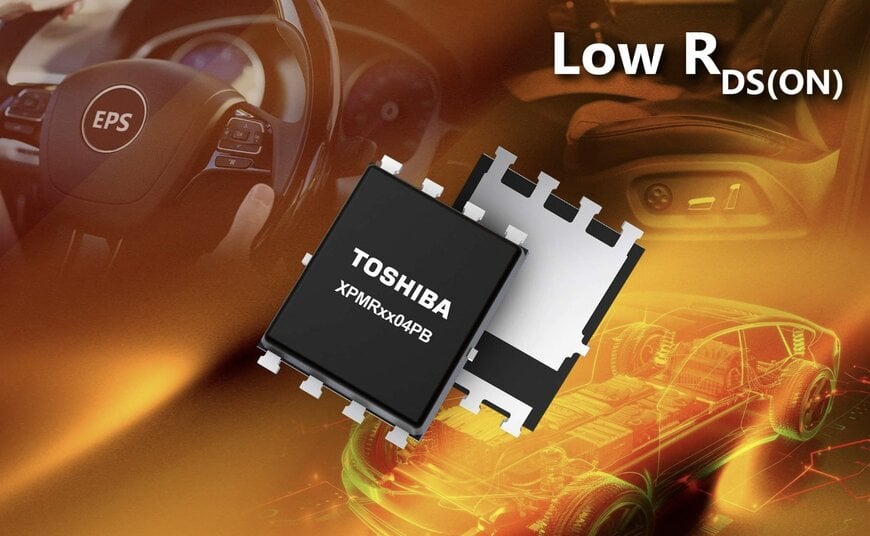
Toshiba is releasing a series of 40-volt N-channel power MOSFETs utilizing advanced post-less packaging to improve efficiency within the automotive semiconductor supply chain. These components are explicitly engineered to manage demanding electrical loads in vehicle inverters, semiconductor relays, mechanical load switches, and electric motor drives.
Internal Packaging Architecture and Current Flow Optimization
The implementation of the SOP Advance (EWF) package format shifts away from conventional internal wire bonding toward a more efficient structural layout. By employing a post-less structure, the design connects the internal silicon chip to the external wire using a solid copper clip rather than traditional internal connection posts. This physical modification eliminates standard internal bottlenecks, directly reducing the electrical resistance along the primary current path.
Furthermore, the architecture incorporates a source-coupled structure that routes the source leads to the underside of the packaging, thereby expanding the physical contact area with the printed circuit board (PCB) mounting pads. This structural layout increases the total usable chip area for internal mounting and enhances current carrying capacity. Consequently, the XPMR5904PB model sustains a maximum direct drain current of 180 amperes, generating a 1.2-fold capacity increase compared to previous generation components utilizing standard SOP Advance (WF) packages with similar electrical characteristics.
Thermal Impedance Reductions and Efficiency Metrics
The physical packaging modifications alter fundamental electrical and thermal performance parameters required for automotive power efficiency. Engineering comparisons between the newly released XPMR5904PB and the preceding XPHR7904PS component demonstrate an approximate 25 percent reduction in drain-source on-resistance.
Concurrently, the modified copper clip and source-coupled design yield an approximate 38 percent decrease in channel-to-case thermal impedance. Lowering these resistance metrics mitigates parasitic power losses and prevents localized heat accumulation, allowing the electrical switching systems to operate with higher efficiency under sustained loads. Alongside the XPMR5904PB, the product line includes the XPMR7404PB and XPMR8504PB variations, which are scheduled for subsequent release to provide engineers with multiple operating specifications.
Automated Optical Inspection and Reliability Compliance
To meet the stringent manufacturing tolerances of the automotive sector, the SOP Advance (EWF) is constructed as a surface-mount package featuring a wettable sidewall structure. This specific exterior geometry ensures the high visibility of the metallic solder joint following the reflow process. The exposed flank allows manufacturing facilities to verify assembly conditions utilizing standard automatic optical inspection (AOI) equipment. Automating the visual verification process on production lines guarantees that the surface-mounted devices meet the strict quality and reliability mandates established by the AEC-Q101 testing standard for automotive electronic components.
Additional Context
This section details technical specifications and competitive benchmarking not included in the original news release.
Within the automotive power electronics sector, 40-volt MOSFETs housed in 5x6 millimeter footprint packages compete primarily on internal package resistance, thermal dissipation capabilities, and automated manufacturing compatibility. Legacy wire-bonded power packages introduce parasitic inductance and limit current handling due to the thin diameter of internal aluminum or gold wires. The transition to solid copper-clip technology aligns this Toshiba architecture with competing industry benchmarks, such as the Nexperia LFPAK56 and the Infineon OptiMOS TDSON-8 series. These comparable technologies similarly replace internal wire bonds with copper clips to achieve drain-source on-resistance values often approaching or falling below 1 milliohm in 40-volt configurations.
A critical differentiator for modern automotive qualification is the inclusion of wettable flanks; earlier generation surface-mount packages obscured the underside solder joints, requiring slower X-ray inspection methods. The implementation of step-cut or wettable sidewall lead frames creates a visible solder meniscus, fulfilling the continuous throughput requirements of modern automated optical inspection systems utilized in vehicle manufacturing lines.
Edited by Aishwarya Mambet, Induportals Editor, with AI assistance.
www.toshiba.com
