
electronics-journal.com
24
'26
Written on Modified on
Automotive 40V Power MOSFET for High-Density Systems
Toshiba introduces an AEC-Q101 compliant semiconductor component engineered to improve heat dissipation and mechanical reliability in vehicle inverters and motor drivers.
www.global.toshiba
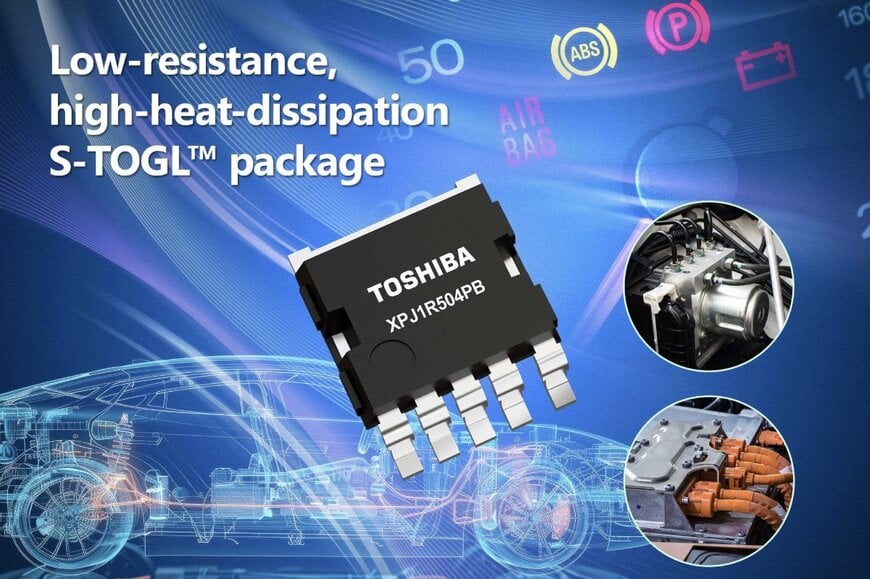
Toshiba has released the XPJ1R504PB, an automotive-grade 40V N-channel power MOSFET designed for high-density mounting in 12V vehicle systems. This semiconductor hardware targets reliable power management in automotive inverters, solid-state relays, and variable frequency drives.
Packaging Architecture and Thermal Management
With the increasing electrification of automotive platforms, components such as variable frequency drives and motor drivers require optimized thermal management and low power losses. The newly introduced MOSFET utilizes a specialized surface-mount package designed to facilitate compact, high-density board integration while maintaining high heat dissipation capabilities. By utilizing a thick copper frame, the package reduces the transient thermal impedance between the channel and the case to 0.76 °C/W. This thermal characteristic decreases conduction losses and limits overall heat generation, structurally improving automotive power system efficiency.
Mechanical Reliability and Electrical Resistance
Automotive electronics operate across wide and fluctuating temperature ranges, making the mechanical integrity of printed circuit board solder joints critical. To address this, the hardware features gull-wing pins that absorb mounting stresses, thereby enhancing the long-term reliability of soldered connections under thermal cycling. Additionally, the component incorporates a pinless internal structure that integrates the source-electrode connection directly with the chip's external conductors.
This architectural choice minimizes parasitic resistance, allowing the device to achieve a maximum on-state resistance of 1.54 mΩ at a gate-source voltage of 10 V. Furthermore, a multi-pin structure for the source conductors optimizes current distribution, enabling the system to reliably handle loads up to 120 A in heavy-duty applications.
Additional Context
This section details technical specifications and competitive benchmarking not included in the original news release.
Within the automotive power semiconductor market, 40V N-channel MOSFETs are primarily benchmarked on on-state resistance, thermal impedance, and the mechanical reliability of the package under severe thermal cycling. The Toshiba S-TOGL package competes directly with gull-wing packages like Nexperia's LFPAK series and leadless packages such as Infineon's sTOLL (Small TO-Leadless) architecture. While traditional leadless packages offer low inductance and high current density, the inclusion of gull-wing pins in the S-TOGL and LFPAK architectures provides superior absorption of mechanical stress caused by the differing thermal expansion coefficients between the printed circuit board and the component. With an on-state resistance of 1.54 mΩ and a 120 A current rating, the XPJ1R504PB operates competitively within the mid-to-high power tier of 12V automotive applications, balancing footprint reduction with stringent board-level reliability requirements.
Edited by Aishwarya Mambet, Induportals Editor, with AI assistance.
www.toshiba.com
