
electronics-journal.com
24
'26
Written on Modified on
Gallium Nitride Switching Technology for Solar Power Optimizers
Infineon supplies 100-volt gallium nitride devices to enhance the efficiency and power density of rooftop solar photovoltaic energy systems.
www.infineon.com
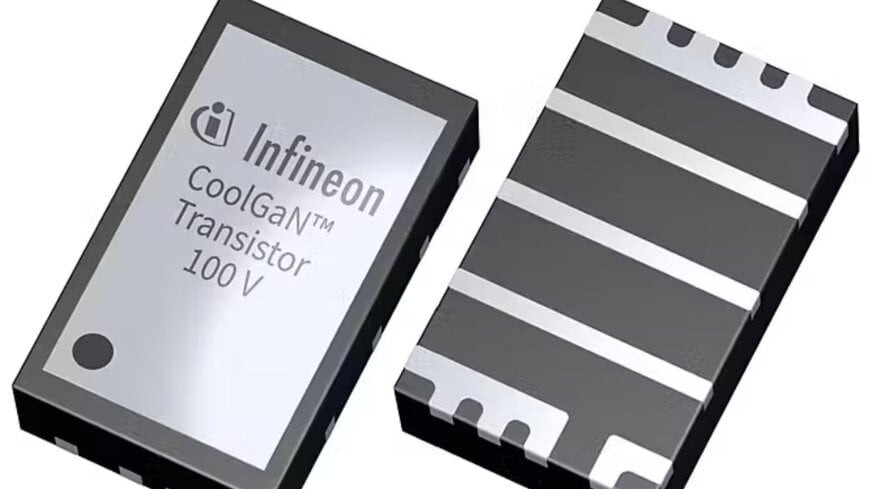
Infineon Technologies AG is supplying its 100-volt gallium nitride (GaN) switching devices to BRC Solar GmbH for integration into panel-level power optimizers. This hardware deployment targets residential and commercial solar power ecosystems, providing a mechanism to maximize photovoltaic energy yield by mitigating the effects of partial shading on individual solar modules.
Mitigating Partial Shading in Photovoltaic Arrays
Rooftop solar installations traditionally implement maximum power-point tracking (MPPT) at the string level. In this configuration, partial shading or debris on a single solar panel disproportionately reduces the electrical output of the entire connected string of panels. By moving MPPT capabilities to the individual panel level using a power optimizer, systems can isolate the underperforming panel. This hardware approach eliminates the performance drag of the weakest module, stabilizing the overall energy yield across the renewable energy infrastructure.
Switching Dynamics of Gallium Nitride Devices
BRC Solar utilizes the 100-volt GaN transistors as the core switching technology within its optimizer units. Compared to conventional silicon metal-oxide-semiconductor field-effect transistors (MOSFETs), GaN technology exhibits fundamentally different switching characteristics. GaN devices offer lower switching losses and can operate at significantly higher switching frequencies. This higher frequency operation allows hardware engineers to reduce the physical size of internal passive components, such as inductors and capacitors, enabling the entire optimizer circuit to fit within a highly restricted footprint. Furthermore, GaN switching generates lower electromagnetic interference (EMI), which simplifies regulatory compliance for radio frequency emissions in residential environments.
Hardware Packaging and Deployment Scale
The 100-volt GaN transistors are housed in a 3-millimeter by 5-millimeter surface-mount package. This specific packaging format allows BRC Solar to achieve a high power density, balancing hardware component costs with physical space constraints.
Discussing the technical rationale for this integration, Johannes Schoiswohl, Senior Vice President at Infineon Technologies AG, noted that utilizing GaN switching enables higher efficiency and greater power density alongside cloud-based performance monitoring within a compact form factor. This expands the functional limits of rooftop solar applications. Similarly, Pascal Ruisinger, CFO at BRC Solar GmbH, indicated that utilizing gallium nitride allows the company to balance cost, physical dimensions, and electrical efficiency in its optimizer hardware to deliver optimized energy output.
Additional Context
This section details technical specifications and competitive benchmarking not included in the original news release.
In the market for 100-volt wide-bandgap power transistors, Infineon competes with semiconductor manufacturers such as Efficient Power Conversion (EPC), Navitas Semiconductor, and Texas Instruments. Traditional silicon-based 100-volt MOSFETs typically suffer from higher gate charge and a characteristic known as reverse recovery charge (Qrr), which severely limits their switching frequencies to the low hundreds of kilohertz before thermal dissipation becomes unmanageable.
GaN high-electron-mobility transistors (HEMTs) inherently lack a body diode, resulting in zero reverse recovery charge. When benchmarked against 100-volt silicon equivalents, 100-volt GaN devices can operate efficiently at switching frequencies exceeding 1 megahertz. This specific lack of reverse recovery losses is the primary objective metric that allows solar optimizer manufacturers to drastically shrink the size of magnetic components and increase the overall power conversion efficiency of the module. Objective benchmarks for selecting these components usually focus on minimizing the drain-source on-resistance (RDS(on)) and the gate charge (Qg) figure of merit.
Edited by Aishwarya Mambet, Induportals Editor, with AI assistance.
www.infineon.com
