
electronics-journal.com
24
'26
Written on Modified on
32-Bit Arm Cortex-M4 MCUs for Industrial Control
Toshiba introduces 120 MHz entry-level MCUs with integrated motor control and analog peripherals for 5 V industrial automation.
www.global.toshiba
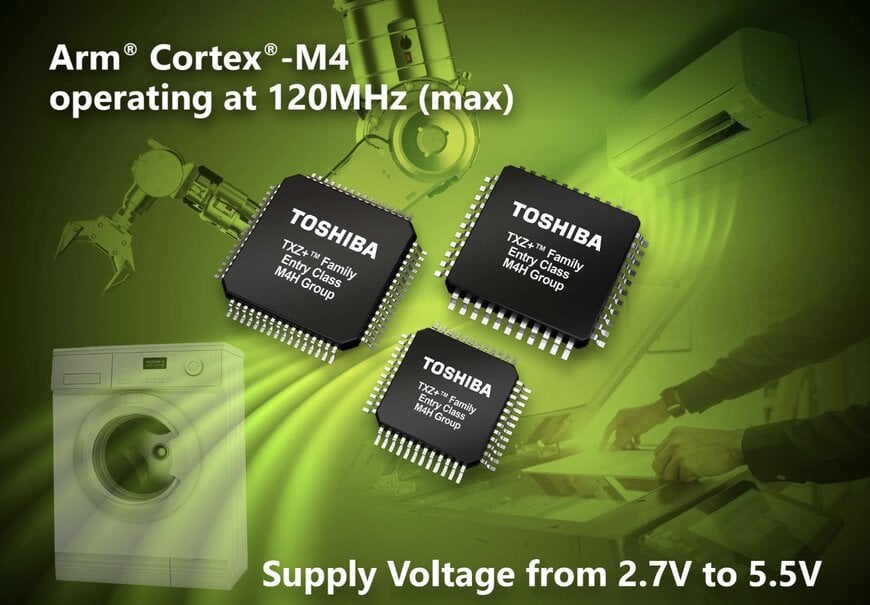
Toshiba Electronics Europe is releasing samples of its M4H group microcontrollers, which utilize a 32-bit Arm Cortex-M4 core to handle system control architectures. These components are designed to manage processing and interface tasks within consumer appliances, such as air conditioners, and industrial automation equipment, including factory robotics and multifunction printers.
Core Processing and Memory Architecture
To meet the real-time processing demands of embedded systems, the microcontrollers operate at clock frequencies up to 120 megahertz. The internal architecture incorporates a hardware floating-point processing unit (FPU) and a memory protection unit (MPU) alongside 256 kilobytes of flash memory and 18 kilobytes of RAM. This processing capacity allows the hardware to handle critical logic execution, interface processing, and time management without requiring secondary coprocessors.
Peripheral Integration and Voltage Tolerances
The hardware supports a broad operating supply voltage ranging from 2.7 to 5.5 volts, making it directly compatible with standard 5-volt industrial power rails. By integrating a 10 megahertz high-speed oscillator with a strict ±1 percent accuracy, the design eliminates the need for external timing components, optimizing printed circuit board space.
The system-on-chip includes a 12-bit analog-to-digital converter (ADC), direct memory access (DMA), and standard communication interfaces such as a universal asynchronous receiver-transmitter (UART), serial peripheral interface (SPI), and inter-integrated circuit (I2C) protocols. Furthermore, an integrated advanced programmable motor driver (A-PMD) enables direct control loops for brushless direct current motors commonly utilized in heavy-duty appliances and factory systems.
Hardware Packaging and Development Ecosystem
To accommodate varying footprint constraints, the devices are packaged in low-profile quad flat packages (LQFP), specifically 64-pin and 48-pin configurations with a 0.5-millimeter pitch, and a 44-pin variant with a 0.8-millimeter pitch. To accelerate the transition from evaluation to mass production, firmware development utilizes drivers compliant with the Common Microcontroller Software Interface Standard (CMSIS), ensuring interoperability with major integrated development environments.
Additional Context
This section details technical specifications and competitive benchmarking not included in the original news release.
Within the landscape of 32-bit microcontrollers targeting industrial and appliance motor control, standard benchmarks include the STMicroelectronics STM32G4 series and the NXP Semiconductors KE1xF family. A primary differentiator for entry-level industrial microcontrollers is their native operating voltage. While many modern Arm Cortex-M4 integrated circuits, such as the STM32G4, are constrained to a maximum 3.6-volt supply, the Toshiba M4H group supports a direct 5.5-volt input. This 5-volt tolerance improves electromagnetic compatibility and noise immunity in electrically harsh environments, such as factory floors and internal appliance chassis, without requiring external step-down voltage regulators.
Additionally, while the 120 megahertz clock speed provides high computational throughput, the memory ratio of 256 kilobytes of flash to 18 kilobytes of RAM is heavily optimized for execution-in-place control algorithms rather than data-intensive buffering tasks. When benchmarked against the NXP KE1xF, which also provides 5-volt robustness and motor control peripherals, the M4H offers a comparable integrated programmable motor driver, ensuring both platforms can autonomously execute sensorless vector control for brushless motors.
Edited by Aishwarya Mambet, Induportals Editor, with AI assistance.
www.toshiba.com
