
electronics-journal.com
26
'26
Written on Modified on
Prototyping Board for Evaluating Isolated Photorelays
Toshiba and MIKROE introduce the Opto 8 Click board to evaluate industrial photorelays.
www.global.toshiba
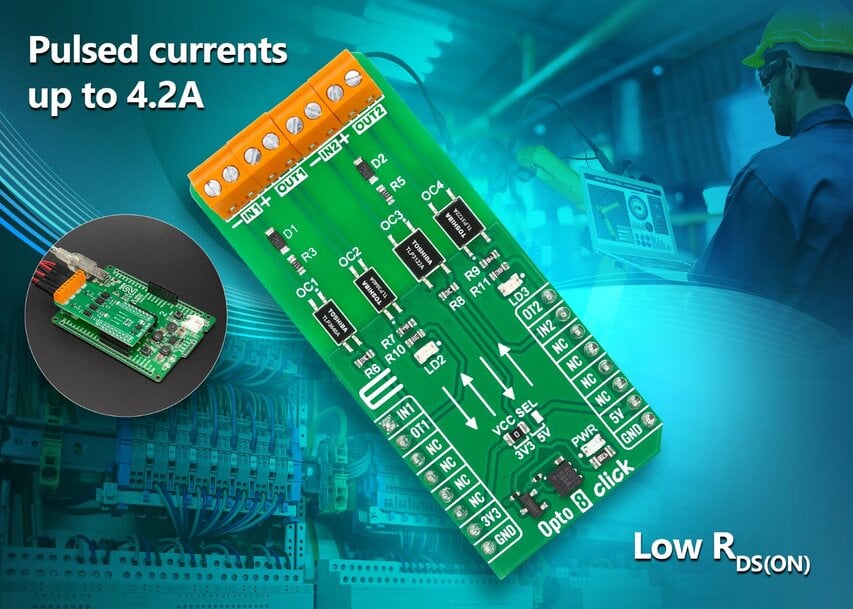
Toshiba Electronics Europe GmbH has announced the availability of the MIKROE Opto 8 Click expansion board, designed for the comparative evaluation and integration of the TLP3640A and TLP3122A photorelays. This hardware interface allows electronics engineers to test galvanic isolation and load switching for microcontroller input and output stages within programmable logic controllers (PLCs) and instrumentation systems.
Switching Characteristics and Isolation
The board symmetrically integrates two TLP3640A photorelays (housed in a 4-pin SO4 package) and two TLP3122A photorelays (4-pin SO6 package). This architecture enables comparative channel evaluation or simultaneous operation to drive larger loads, such as DC motors. The output stage of both devices supports an OFF-state blocking voltage of 60 V. The TLP3640A conducts a constant ON-state current of 1 A, with a pulsed current of up to 3 A and maximum switching times of 0.5 ms (tON) and 0.2 ms (tOFF). Meanwhile, the TLP3122A offers a constant current of 1.4 A and a pulsed current of 4.2 A, with respective switching times of 3 ms and 1 ms. The components ensure a minimum isolation voltage (BVS) of 3,750 Vrms, complying with UL 1577 and VDE safety standards.
Thermal Performance and Software Ecosystem
Both integrated MOSFET devices feature a low ON-state resistance (RDS(ON))—typically 0.14 Ω for the TLP3640A and 0.13 Ω for the TLP3122A—limiting thermal dissipation during conduction. The OFF-state leakage current (IOFF) is restricted to 1 µA (max). These electrical specifications guarantee continuous operation within an industrial temperature range of -40 °C to 110 °C. On the software side, the board integrates with the MIKROE development kit (mikroSDK), providing open-source libraries and unified application programming interfaces (APIs) to directly embed isolated switching into the host microcontroller's code.
Additional Context: This section details technical specifications not included in the original announcement.
In programmable logic controller (PLC) design, photorelays (also known as photo-MOSFET solid-state relays) are increasingly replacing traditional electromechanical relays (EMRs). Unlike a conventional relay that uses a magnetic coil to physically move metal contacts, a photorelay utilizes a light-emitting diode (LED) on the input side. This LED emits infrared light that passes through a transparent optical isolation barrier and strikes a photodiode array. The photonic energy is converted into a voltage that drives the gates of two back-to-back mounted MOSFETs on the output stage. This solid-state architecture eliminates mechanical wear, contact bounce, and electrical arcing. It thereby significantly increases the component's lifespan and switching reliability while maintaining strict galvanic isolation to protect low-voltage microcontrollers from destructive transients originating from industrial power loads.
Edited by Lekshman Ramdas, Induportals editor – adapted by AI.
www.toshiba.semicon-storage.com
