
electronics-journal.com
13
'26
Written on Modified on
Keysight Delivers New Network Cybersecurity Test Platform
Scalable 4x100GE test solution provides hyperscale traffic generation and cybersecurity validation in a compact 1 rack unit footprint.
www.keysight.com
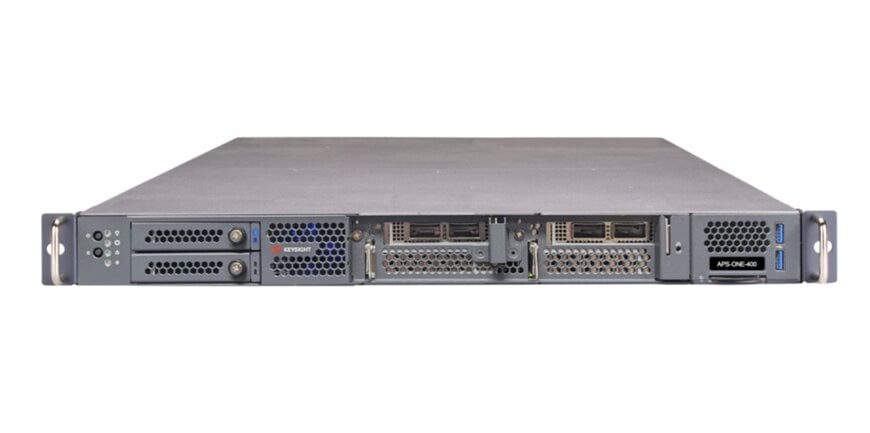
Keysight Technologies has announced the APS-ONE-400, a modular 4x100GE network application and cybersecurity test platform designed for a compact 1 rack unit (RU) footprint. The appliance enables network equipment manufacturers, service providers, and data center operators to generate Layer 4-7 application workloads, encrypted traffic streams, and high-volume data flows to validate network infrastructure security and performance boundaries.
Workload Complexity and Lab Footprint Optimization
Modern network architectures experience complex, high-volume traffic flows that combine legitimate operational data, security vulnerabilities, and traffic patterns such as post-quantum cryptography (PQC) transport layer security (TLS) encryption. Concurrently, security models like Zero Trust Network Access (ZTNA) and data-intensive "Elephant Flows"—which are standard inside artificial intelligence and large language model compute clusters—demand rigorous empirical validation before production deployment. Evaluating these diverse environments historically required separate, dedicated instrumentation tools, which elevated operational capital costs and restricted laboratory rack resources.
The introduction of the test platform addresses these scaling constraints by unifying application and cryptographic simulation within the modular hardware layout. The architecture handles hyperscale L4-7 traffic emulation, ZTNA policy validation, and high-stress security vulnerability injections within a physical footprint engineered to minimize laboratory floor space, thermal cooling profiles, and electrical power draws.
Performance Benchmarks and Fanout Flexibility
Operating as a standalone test instrument, the platform provides dedicated hardware-accelerated processing blocks to sustain baseline performance metrics:
- Layer 4-7 Throughput: Generates up to 400 gigabits per second (Gbps) of stateful application traffic.
- Encrypted Throughput: Delivers 380 Gbps of dedicated, hardware-accelerated TLS traffic configured with post-quantum cryptography parameters.
- Elephant Flow Capacity: Simulates up to 95 Gbps of sustained high-bandwidth data bursts to test switching fabrics under AI cluster conditions.
To support integration across varied network topologies, the physical interfaces feature fanout configurations enabling operations at 100GE, 25GE, and 10GE line rates.
Hyperscale Clustering and Scalable Expansion
The platform utilizes a modular, "pay-as-you-grow" structural framework, allowing engineering labs to expand test infrastructure in lockstep with evolving verification demands. The hardware is fully compatible with pre-existing deployments of the vendor's application and security testing ecosystem, linking with instruments such as the APS-ONE-100.
When clustered alongside the flagship management components—such as the APS-M8400 appliance or the APS-M1010 management controller—the interconnected testbed scales to emulate hyperscale data center and telecommunications infrastructure environments. In a fully scaled cluster configuration, the platform achieves aggregated performance limits including 16 terabits per second (Tbps) of Layer 4-7 simulation, 15 Tbps of concurrent TLS encrypted traffic, up to 20 billion simultaneous network connections, and a connection establishment rate of 25 million TLS sessions per second.
Additional Context
This section details technical specifications not included in the original news release.
Validating network infrastructure against Elephant Flows and post-quantum cryptography (PQC) algorithms requires massive computing overhead at the network interface layer. Elephant flows represent continuous, high-bandwidth data streams that saturate individual network paths, causing routing buffers to overflow and creating severe packet jitter if the switching fabric fails to manage dynamic load balancing.
To evaluate these phenomena alongside encrypted payloads, the test appliance integrates field-programmable gate arrays and dedicated cryptographic acceleration ASICs. These processors offload the intense computational load required by PQC algorithms, which use complex lattice-based mathematical structures that demand significantly more processing cycles than legacy RSA or Elliptic Curve algorithms. By executing cryptographic handshakes directly in hardware, the system maintains multi-hundred-gigabit line rates without introducing latency, providing clean replication of high-density data center workflows.
Edited by Romila DSilva, Induportals Editor, with AI assistance.
Hyperscale Clustering and Scalable Expansion
The platform utilizes a modular, "pay-as-you-grow" structural framework, allowing engineering labs to expand test infrastructure in lockstep with evolving verification demands. The hardware is fully compatible with pre-existing deployments of the vendor's application and security testing ecosystem, linking with instruments such as the APS-ONE-100.
When clustered alongside the flagship management components—such as the APS-M8400 appliance or the APS-M1010 management controller—the interconnected testbed scales to emulate hyperscale data center and telecommunications infrastructure environments. In a fully scaled cluster configuration, the platform achieves aggregated performance limits including 16 terabits per second (Tbps) of Layer 4-7 simulation, 15 Tbps of concurrent TLS encrypted traffic, up to 20 billion simultaneous network connections, and a connection establishment rate of 25 million TLS sessions per second.
Additional Context
This section details technical specifications not included in the original news release.
Validating network infrastructure against Elephant Flows and post-quantum cryptography (PQC) algorithms requires massive computing overhead at the network interface layer. Elephant flows represent continuous, high-bandwidth data streams that saturate individual network paths, causing routing buffers to overflow and creating severe packet jitter if the switching fabric fails to manage dynamic load balancing.
To evaluate these phenomena alongside encrypted payloads, the test appliance integrates field-programmable gate arrays and dedicated cryptographic acceleration ASICs. These processors offload the intense computational load required by PQC algorithms, which use complex lattice-based mathematical structures that demand significantly more processing cycles than legacy RSA or Elliptic Curve algorithms. By executing cryptographic handshakes directly in hardware, the system maintains multi-hundred-gigabit line rates without introducing latency, providing clean replication of high-density data center workflows.
Edited by Romila DSilva, Induportals Editor, with AI assistance.
