
electronics-journal.com
30
'26
Written on Modified on
Renesas Launches Gen 3 MRDIMM Chipset Solutions
The new solutions are designed to address the growing demand for higher memory bandwidth driven by AI data centers, cloud infrastructure and accelerated compute workloads.
www.renesas.com
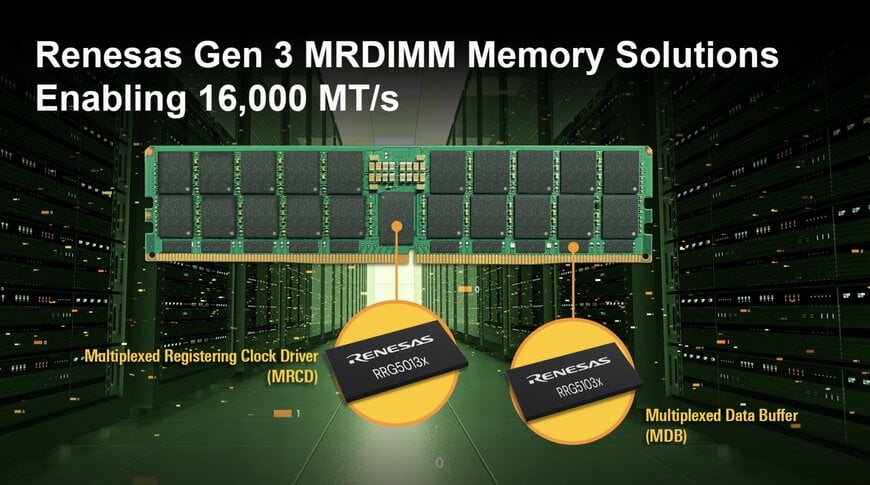
Renesas Electronics Corporation has announced its third-generation (Gen 3) DDR5 Multiplexed Rank Dual In-Line Memory Module (MRDIMM) chipset solutions designed for server-class memory applications. The chipset supports data transfer speeds up to 16,000 mega transfers per second (MT/s) to expand memory bandwidth in artificial intelligence (AI) data centers, cloud infrastructure, and accelerated compute platforms.
Showcase at FMS 2026
Renesas will demonstrate its memory interface components for Gen 3 MRDIMMs at the Future of Memory and Storage Conference (FMS 2026), held in Santa Clara, California, from August 4 to 6, 2026 (Booth #807).
The featured component portfolio includes the third-generation Multiplexed Registering Clock Driver (MRCD, part number RRG5013) and the Multiplexed Data Buffer (MDB, part number RRG5103), both engineered to support next-generation MRDIMM operational requirements.
Bandwidth Expansion and Platform Compatibility
The Gen 3 MRDIMM chipset provides a 25 percent increase in memory bandwidth compared to Renesas’ second-generation (Gen 2) solutions while preserving compatibility with existing DDR5 infrastructure and standard DIMM form factors. This allows server architectures to increase throughput without necessitating structural platform redesigns.
The complete chipset platform encompasses the MRCD, MDB, Power Management ICs (PMIC), Serial Presence Detect (SPD) Hubs, and integrated temperature sensors. This unified platform design supports generational scaling for MRDIMM implementations while maintaining design continuity across hardware deployments.
System Robustness and Power Efficiency
Building on the architecture introduced in the Gen 2 platform, the Gen 3 solution incorporates features to enhance system visibility and operational robustness. Key features include the Device Equalization Self-Train Mode (DESTM) Quality Indication Status, which allows users to calibrate timing parameters and receiver equalization training to optimize signal margins.
The Gen 3 MRDIMM solutions also incorporate system-level power efficiency features to help operators manage thermal constraints and power budgets within dense server environments.
Additional Context
This section details technical specifications not included in the original news release.
Multiplexed Rank Dual In-Line Memory Modules (MRDIMMs) achieve high bandwidth by operating two ranks of DDR5 DRAM in parallel over a single host interface. Instead of accessing ranks sequentially as in standard Registered DIMMs (RDIMMs), the MRCD (Multiplexed Registering Clock Driver) and MDBs (Multiplexed Data Buffers) multiplex two 32-bit data signals from two separate DRAM ranks into a single 64-bit high-speed data stream sent to the host memory controller at double the clock frequency.
Operating high-speed parallel interfaces at speeds up to 16,000 MT/s introduces severe physical-layer signal integrity challenges, including inter-symbol interference (ISI), crosstalk, and channel attenuation. The Device Equalization Self-Train Mode (DESTM) addresses these channel degradation effects by executing automated training sequences at the physical layer (PHY). DESTM optimizes decision feedback equalization (DFE) taps and continuous-time linear equalization (CTLE) settings on the MDB and MRCD receivers, providing quantitative status metrics to ensure maximum eye-diagram opening and signal margin under thermal fluctuations.
Edited by Romila DSilva, Induportals Editor, with AI assistance.
www.renesas.com
