
electronics-journal.com
17
'26
Written on Modified on
Infrared LED Technology Enhances Intelligent Vision Systems
ams OSRAM introduces IR:6 thin-film infrared LED technology for higher-performance machine vision, automotive, biometric, and industrial sensing applications.
www.rutronik.com
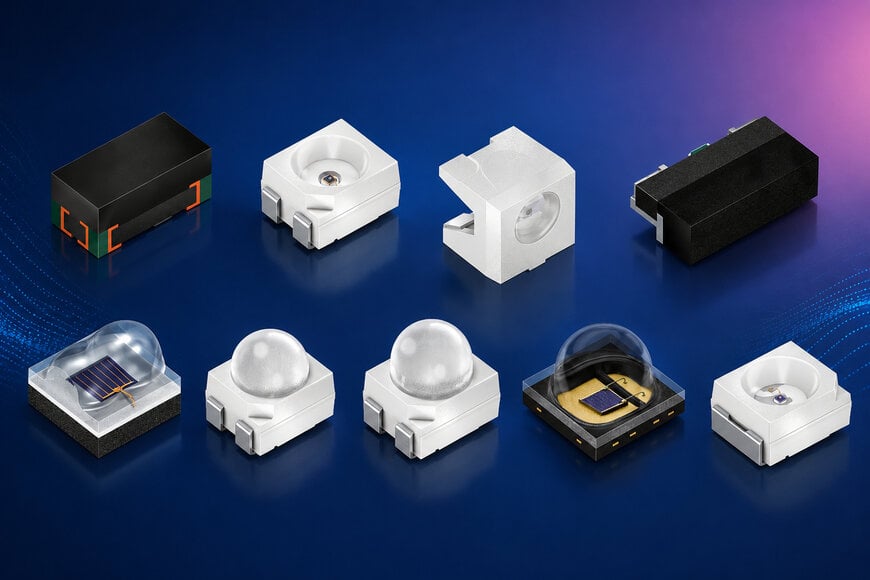
Infrared illumination has become a core enabling technology for AI-driven vision systems used in machine vision, robotics, automotive electronics, biometrics, industrial automation, and medical imaging. ams OSRAM has expanded its infrared LED portfolio with the IR:6 thin-film technology, designed to increase optical performance and energy efficiency while maintaining compatibility with a broad range of infrared sensing applications.
Thin-film infrared LED architecture improves optical efficiency
Modern image sensors and AI-based vision algorithms require infrared light sources capable of delivering higher optical power without increasing energy consumption or thermal load. The IR:6 thin-film semiconductor technology addresses these requirements through improvements in chip efficiency, optical extraction, and thermal management.
Compared with the previous generation of infrared LED chips, the IR:6 platform delivers up to 35% higher radiant output and up to 42% greater efficiency. An optimized chip structure also improves heat dissipation, enabling reliable operation under demanding pulsed-current conditions and extending device lifetime in continuous sensing applications.
Higher radiant output allows longer sensing distances and improved image quality, while increased efficiency helps reduce power consumption and extend battery operating time in portable electronic systems.
Infrared LED portfolio supports multiple sensing applications
The IR:6 technology serves as the basis for a complete infrared LED portfolio ranging from compact Chip LEDs to high-power emitters for industrial and automotive applications. Devices are available with dominant wavelengths of 850 nm, 920 nm, and 940 nm, allowing engineers to optimize illumination according to detector sensitivity and application requirements.
The introduction of a 920 nm wavelength provides a balance between the higher sensor sensitivity associated with shorter wavelengths and the lower visible red glow characteristic of longer wavelengths. This makes the wavelength suitable for applications including biometric authentication, facial recognition, driver monitoring, and security imaging.
The portfolio includes compact Chip LEDs and FIREFLY emitters for AR/VR headsets and smart glasses, SIDELED and TOPLED devices for home, building, and factory automation, OSLON Black IR:6 C-Series products for driver and occupant monitoring systems, and OSLON P1616 together with Power TOPLED Lens families for machine vision, industrial imaging, and security equipment.
Multiple package configurations and beam patterns enable designers to select either focused illumination or wide-angle, highly uniform infrared light distribution depending on system requirements.
Machine vision and automotive data ecosystem applications
The technology targets intelligent sensing systems where infrared illumination directly influences image quality and AI performance. Typical application areas include machine vision, robotics, factory automation, driver and occupant monitoring systems, biometric authentication, gesture recognition, smart home devices, security and surveillance cameras, medical imaging, and AR/VR devices.
Automotive-qualified product variants are available for vehicle applications requiring compliance with automotive reliability standards. The portfolio also supports the growing automotive data ecosystem, where in-cabin monitoring systems and advanced driver assistance functions rely on high-quality infrared imaging for occupant detection and driver monitoring.
Engineering improvements for next-generation infrared emitters
The IR:6 platform incorporates several semiconductor design enhancements that contribute to measurable performance improvements. These include higher intrinsic chip efficiency, a centrally positioned bond pad that improves current distribution while reducing forward voltage, enhanced surface texturing to increase light extraction efficiency, and optimized reflector structures that minimize optical losses.
These improvements enable higher radiant flux without increasing package dimensions, allowing many IR:6 devices to serve as drop-in replacements for previous infrared LED generations while reducing overall system power consumption.
Additional Context: This section details technical specifications and competitive benchmarking not included in the original product announcement
Infrared LEDs used in machine vision, biometrics, and automotive sensing are generally evaluated using measurable parameters including radiant flux, wall-plug efficiency, wavelength accuracy, thermal resistance, forward voltage, optical output stability during pulsed operation, and package thermal performance. These metrics determine sensing distance, image quality, power consumption, and long-term reliability.
Manufacturers including ams OSRAM, Vishay Intertechnology, ROHM Semiconductor, LITEON Technology, and Broadcom supply infrared LED solutions for industrial, automotive, security, and medical markets. Competitive differentiation typically focuses on optical power, efficiency, wavelength availability, package size, thermal characteristics, and automotive qualification rather than software functionality.
A distinguishing characteristic of the IR:6 platform is the introduction of a 920 nm wavelength alongside conventional 850 nm and 940 nm options. The additional wavelength provides a compromise between photodiode sensitivity and reduced visible red emission, making it suitable for AI-based machine vision, biometric authentication, and driver monitoring systems. Compared with the previous IR chip generation, IR:6 achieves measurable improvements of up to 35% higher radiant output and up to 42% greater efficiency while remaining available across multiple package families for low- and high-power infrared emitters.
Edited by Sucithra Mani, Induportals editor – adapted by AI.
www.rutronik24.com
