
electronics-journal.com
23
'26
Written on Modified on
Alps Alpine Launches Automated Assembly Encoder
The EC11P Series SMD-type rotary encoder delivers 30 percent higher signal detection for automotive control panels.
www.alpsalpine.com
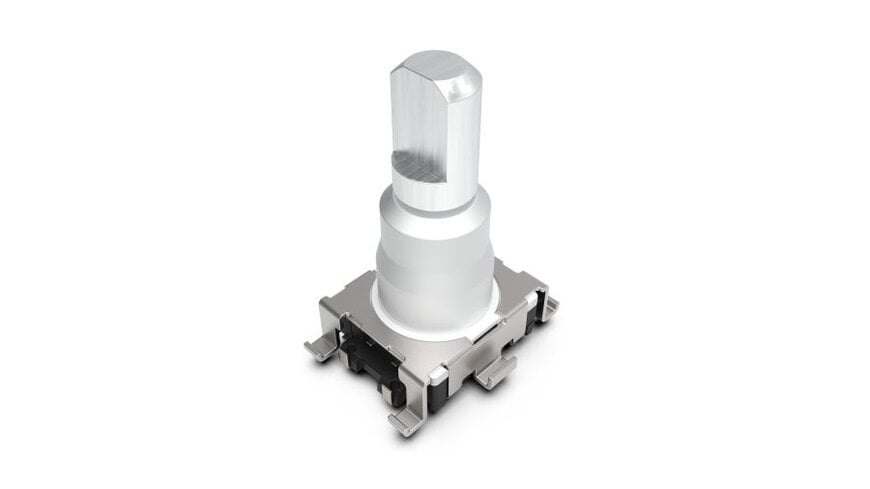
New Automotive Encoder Enables Automated Assembly and Reduces Environmental Impact
Alps Alpine has announced the development of the EC11P Series, an 11 mm surface-mount device (SMD) automotive encoder engineered primarily for automotive air-conditioning controls and other high-reliability interfaces. Mass production is scheduled to commence in November 2026. Unlike traditional automotive encoders that rely on Dual In-line Package (DIP) mounting—which requires manual insertion and through-hole soldering—the new EC11P Series utilizes an SMD configuration. This shift allows the components to be integrated seamlessly into fully automated pick-and-place assembly lines, significantly reducing manual labor, improving production throughput, and lowering overall mounting costs.
The surface-mount design also enhances printed circuit board (PCB) design flexibility. By eliminating the need for through-hole processing, engineers can implement single-side mounting, leading to more compact board layouts and simplified, cost-effective PCB configurations. Performance-wise, the EC11P Series improves signal detection by 30 percent compared to Alps Alpine’s conventional models. This ensures stable, reliable signal acquisition over an extended lifecycle, even as internal mechanical components begin to wear. Rated for 100,000 rotational cycles and 100,000 switch operations, the device features a detent torque of 10 ± 4 mN·m and operates reliably across a wide temperature range of -40°C to +85°C.
Additional Context
This section provides technological and market background not explicitly detailed in the original release.
The transition from through-hole (DIP) to surface-mount (SMD) technology for mechanical electromechanical components, like rotary encoders, represents a critical step in modern automotive electronics manufacturing. While SMD components are standard for microchips and passive components, bulky mechanical switches often lagged behind due to the intense physical stresses (pushing and turning) exerted by the end-user. The soldering joints in through-hole components inherently provide greater mechanical anchoring to the PCB. Developing an SMD encoder that can withstand continuous user interaction—including an operating force of 4±2 N—without ripping the solder pads off the board requires advanced structural design and metallurgical considerations.
Furthermore, the elimination of wave soldering—the traditional method for mass-soldering DIP components—yields substantial environmental and operational benefits. Wave soldering necessitates liquid flux, which subsequently requires chemical washing, generating hazardous wastewater. By moving to an SMD reflow soldering process, manufacturers dramatically reduce flux consumption and eliminate post-solder aqueous cleaning steps, aligning with the automotive industry's push for greener, more sustainable manufacturing footprints. The 30 percent improvement in signal detection also mitigates "contact bounce" and "sliding noise"—common failure modes in contact-type incremental encoders where mechanical vibrations and burrs induce erroneous digital pulses over time.
Edited by an industrial journalist, Lekshman Ramdas, with AI assistance.
www.alpsalpine.com
Alps Alpine has announced the development of the EC11P Series, an 11 mm surface-mount device (SMD) automotive encoder engineered primarily for automotive air-conditioning controls and other high-reliability interfaces. Mass production is scheduled to commence in November 2026. Unlike traditional automotive encoders that rely on Dual In-line Package (DIP) mounting—which requires manual insertion and through-hole soldering—the new EC11P Series utilizes an SMD configuration. This shift allows the components to be integrated seamlessly into fully automated pick-and-place assembly lines, significantly reducing manual labor, improving production throughput, and lowering overall mounting costs.
The surface-mount design also enhances printed circuit board (PCB) design flexibility. By eliminating the need for through-hole processing, engineers can implement single-side mounting, leading to more compact board layouts and simplified, cost-effective PCB configurations. Performance-wise, the EC11P Series improves signal detection by 30 percent compared to Alps Alpine’s conventional models. This ensures stable, reliable signal acquisition over an extended lifecycle, even as internal mechanical components begin to wear. Rated for 100,000 rotational cycles and 100,000 switch operations, the device features a detent torque of 10 ± 4 mN·m and operates reliably across a wide temperature range of -40°C to +85°C.
Additional Context
This section provides technological and market background not explicitly detailed in the original release.
The transition from through-hole (DIP) to surface-mount (SMD) technology for mechanical electromechanical components, like rotary encoders, represents a critical step in modern automotive electronics manufacturing. While SMD components are standard for microchips and passive components, bulky mechanical switches often lagged behind due to the intense physical stresses (pushing and turning) exerted by the end-user. The soldering joints in through-hole components inherently provide greater mechanical anchoring to the PCB. Developing an SMD encoder that can withstand continuous user interaction—including an operating force of 4±2 N—without ripping the solder pads off the board requires advanced structural design and metallurgical considerations.
Furthermore, the elimination of wave soldering—the traditional method for mass-soldering DIP components—yields substantial environmental and operational benefits. Wave soldering necessitates liquid flux, which subsequently requires chemical washing, generating hazardous wastewater. By moving to an SMD reflow soldering process, manufacturers dramatically reduce flux consumption and eliminate post-solder aqueous cleaning steps, aligning with the automotive industry's push for greener, more sustainable manufacturing footprints. The 30 percent improvement in signal detection also mitigates "contact bounce" and "sliding noise"—common failure modes in contact-type incremental encoders where mechanical vibrations and burrs induce erroneous digital pulses over time.
Edited by an industrial journalist, Lekshman Ramdas, with AI assistance.
www.alpsalpine.com
