
electronics-journal.com
01
'26
Written on Modified on
Dual-Channel Digital Isolators for Low-Power Industrial Signal Isolation
Toshiba Electronic Devices & Storage Corporation releases the DCL32xx00 Series digital isolators to eliminate ground loops in compact industrial equipment.
www.global.toshiba
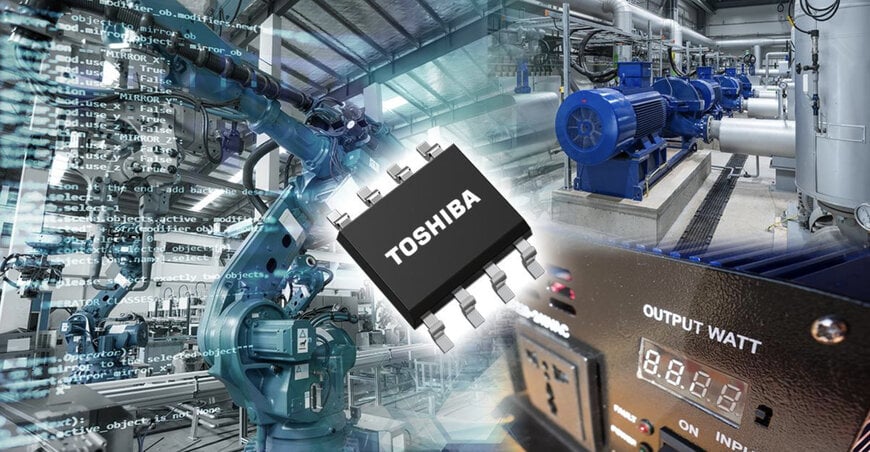
Industrial automation systems, motor drives, and programmable logic controllers require dependable galvanic isolation to prevent high-voltage transients, ground loops, and electromagnetic interference from corrupting sensitive low-voltage control logic. To address these demands while lowering overall system thermal loads, Toshiba Electronic Devices & Storage Corporation has introduced the DCL32xx00 Series, a family of four dual-channel standard digital isolators designed to cut operating current in compact industrial machinery.
Engineering Challenges in Industrial Signal Isolation
In factory automation environments, equipment such as programmable logic controllers, industrial actuators, and variable-frequency inverters operate under severe electrical noise generated by high-speed switching devices and inductive loads. Signals routed across disparate ground potentials risk severe ground loops and equipment degradation if not physically decoupled.
Traditional galvanic isolation techniques often introduce design trade-offs between physical footprint, long-term degradation over operating lifetimes, and elevated electrical power consumption. As control cabinets move toward higher component densities, engineers face stringent thermal budgets that require individual semiconductor components to minimize current draw without compromising transmission stability or safety margins.
Magnetic Coupling Architecture and Operating Principles
The DCL32xx00 Series incorporates proprietary magnetic coupling isolation transmission technology, packaging integrated modulation and demodulation silicon dice alongside dedicated insulation layers within an industry-standard SOIC8-N package. Signal transmission across the isolation boundary occurs via localized magnetic field coupling rather than optical emissions.
This architecture integrates internal circuitry specifically designed to minimize power dissipation in the isolation signal transmission stage. The devices operate at a typical current consumption of 0.2 mA per channel at a 1 Mbps data transmission rate, measured under test conditions of 3.3 V supply voltages, a 15 pF load capacitance, and an ambient temperature of 25 degrees Celsius. The internal transceiver architecture handles communication speeds up to a maximum data rate of 25 Mbps.
Channel Configurations and Electrical Specifications
The series provides engineers with two distinct channel topologies to accommodate standard industrial serial interfaces:
- The DCL320C00 and DCL320D00 models feature two forward channels and zero reverse channels, tailored for unidirectional signal paths and clock-synchronized lines such as Inter-Integrated Circuit communications.
- The DCL321C00 and DCL321D00 models offer one forward channel and one reverse channel, enabling bidirectional data exchange across isolated domains for asynchronous protocols such as Universal Asynchronous Receiver-Transmitter interfaces.
All four devices are rated for a minimum insulation withstand voltage of 3,000 Vrms. The components support supply voltages across a 2.25 V to 5.5 V direct-current range and maintain operational reliability across an industrial temperature range spanning -40 to 125 degrees Celsius.
Deployment in Industrial Control Workflows
The DCL32xx00 Series functions primarily at field-level input and output interfaces, switching power supplies, sensor nodes, and motor control subsystems. In programmable logic controller backplanes and distributed I/O blocks, the devices route digital control words and status flags between the central processing unit and field-side transceiver stages.
By combining the four dual-channel devices with the existing DCL34xx0B quad-channel family, designers can match isolation channels precisely to subsystem pinouts, eliminating unused isolated channels on dense printed circuit boards. The reduction in per-channel dynamic current also simplifies auxiliary power rail sizing in isolated dc-dc converter modules across distributed automation networks.
Additional Context:
This section details technical specifications and competitive benchmarking not included in the original product announcement.
Digital isolation components for industrial systems primarily compete across three technological approaches: traditional optocouplers, capacitive isolators, and magnetic transformer-based couplers.
Legacy optocouplers rely on light-emitting diodes that experience output degradation over time due to aging and thermal stress, generally requiring drive currents between 2 mA and 10 mA to maintain signal margins. By contrast, magnetic and capacitive digital isolators achieve service lives exceeding several decades while significantly reducing current consumption.
Standard dual-channel digital isolators in the industrial market segment typically operate with quiescent or low-speed current draws ranging from 0.5 mA to 1.5 mA per channel. Achieving 0.2 mA per channel at 1 Mbps positions the DCL32xx00 Series among the lowest power-consuming magnetic isolation devices in the 25 Mbps mid-speed category.
Furthermore, industrial equipment standards, such as IEC 61131-2 for programmable controllers and IEC 60664-1 for insulation coordination, mandate robust creepage and clearance distances alongside verified withstand ratings. Toshiba's 3,000 Vrms rating aligns with standard basic isolation requirements for 230 V to 400 V industrial mains supplies, providing sufficient protection against typical industrial line surges without requiring wide-body package variants for medium-voltage isolation boundaries.
Edited by Natania Lyngdoh, Induportals editor, with AI assistance.
www.toshiba.semicon-storage.com
Deployment in Industrial Control Workflows
The DCL32xx00 Series functions primarily at field-level input and output interfaces, switching power supplies, sensor nodes, and motor control subsystems. In programmable logic controller backplanes and distributed I/O blocks, the devices route digital control words and status flags between the central processing unit and field-side transceiver stages.
By combining the four dual-channel devices with the existing DCL34xx0B quad-channel family, designers can match isolation channels precisely to subsystem pinouts, eliminating unused isolated channels on dense printed circuit boards. The reduction in per-channel dynamic current also simplifies auxiliary power rail sizing in isolated dc-dc converter modules across distributed automation networks.
Additional Context:
This section details technical specifications and competitive benchmarking not included in the original product announcement.
Digital isolation components for industrial systems primarily compete across three technological approaches: traditional optocouplers, capacitive isolators, and magnetic transformer-based couplers.
Legacy optocouplers rely on light-emitting diodes that experience output degradation over time due to aging and thermal stress, generally requiring drive currents between 2 mA and 10 mA to maintain signal margins. By contrast, magnetic and capacitive digital isolators achieve service lives exceeding several decades while significantly reducing current consumption.
Standard dual-channel digital isolators in the industrial market segment typically operate with quiescent or low-speed current draws ranging from 0.5 mA to 1.5 mA per channel. Achieving 0.2 mA per channel at 1 Mbps positions the DCL32xx00 Series among the lowest power-consuming magnetic isolation devices in the 25 Mbps mid-speed category.
Furthermore, industrial equipment standards, such as IEC 61131-2 for programmable controllers and IEC 60664-1 for insulation coordination, mandate robust creepage and clearance distances alongside verified withstand ratings. Toshiba's 3,000 Vrms rating aligns with standard basic isolation requirements for 230 V to 400 V industrial mains supplies, providing sufficient protection against typical industrial line surges without requiring wide-body package variants for medium-voltage isolation boundaries.
Edited by Natania Lyngdoh, Induportals editor, with AI assistance.
www.toshiba.semicon-storage.com
