
electronics-journal.com
29
'26
Written on Modified on
Renesas Launches Ultra-Low Power RL78/G21 Microcontroller
The component optimizes smart appliance control while offering ±4 kV ESD robustness.
www.renesas.com
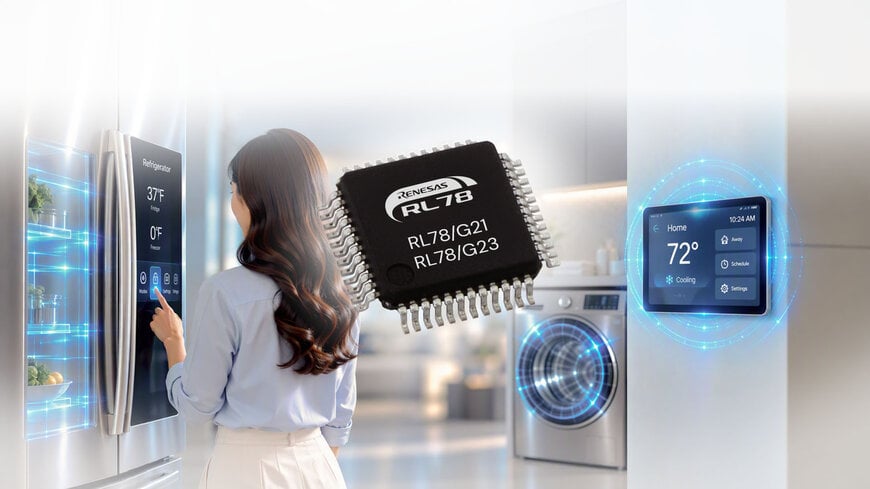
Renesas Electronics has announced the expansion of its 16-bit microcontroller family with the launch of the RL78/G21, an ultra-low power chip specifically optimized for controlling smart appliance systems (air conditioners, refrigerators, washing machines). In parallel, the manufacturer is enriching its existing RL78/G23 range by integrating additional capacitive touch channels to meet the growing demand for sophisticated human-machine interfaces (HMIs).
BOM Reduction and Energy Efficiency
Leveraging advanced power management technologies, the RL78/G21 features an operating current of just 34 μA/MHz, nearly halving power consumption compared to previous generations (RL78/G13). This efficiency allows for reduced battery capacity and the downsizing of power supply circuits. Furthermore, the integration of a high-speed oscillator (HOCO) with ±1.0% precision and 4 KB of data flash memory eliminates the need to add an external oscillator and an EEPROM on the board, thereby reducing the overall bill of materials (BOM) cost. The microcontroller offers 128 KB or 256 KB of code flash memory and adds a UARTA interface for flexible sensor integration.
Increased Reliability and Expanded Touch Interfaces
To guarantee reliability in harsh electromechanical environments, the RL78/G21 integrates a self-diagnostic function compliant with the IEC 60730 safety standard and offers an exceptional tolerance to electrostatic discharge (ESD) of ±4 kV HBM (Human Body Model). Regarding interfaces, the new iteration of the RL78/G23 increases the number of touch channels from 14/16 to 24/25 channels (for the 44- and 48-pin versions). Both series share hardware security features (unique ID, flash read protection) that prevent cloning, tampering, and unauthorized access, ensuring the protection of end devices.
Additional Context: Human Body Model (HBM) and ESD Robustness
This section details electromagnetic compatibility (EMC) principles not included in the original release.
In consumer electronics and home appliances (washing machines, ovens, air conditioners), electrostatic discharge (ESD) is one of the leading causes of hardware failure. The HBM (Human Body Model) standard simulates the electrical discharge produced when a human user, charged with static electricity (e.g., after walking on a synthetic carpet), touches a device's interface. Most standard microcontrollers on the market offer HBM ESD protection limited to ±2 kV. By increasing this intrinsic tolerance to ±4 kV directly on the silicon, the RL78/G21 allows printed circuit board (PCB) designers to frequently eliminate costly external protection components, such as TVS (Transient Voltage Suppressor) diodes or varistors. This integration is particularly critical for capacitive touch-based human-machine interfaces, where physical isolation is minimal and the injection of electrostatic noise can not only damage the chip but also cause "phantom" touch triggers.
Edited by industrial journalist Lekshman Ramdas, with AI assistance.
www.renesas.com
