
electronics-journal.com
01
'26
Written on Modified on
Power MOSFETs improve the efficiency of switched-mode power supplies
Toshiba introduces a 40V N-channel MOSFET designed to enhance power density and thermal management within the automotive and industrial power sectors.
www.global.toshiba
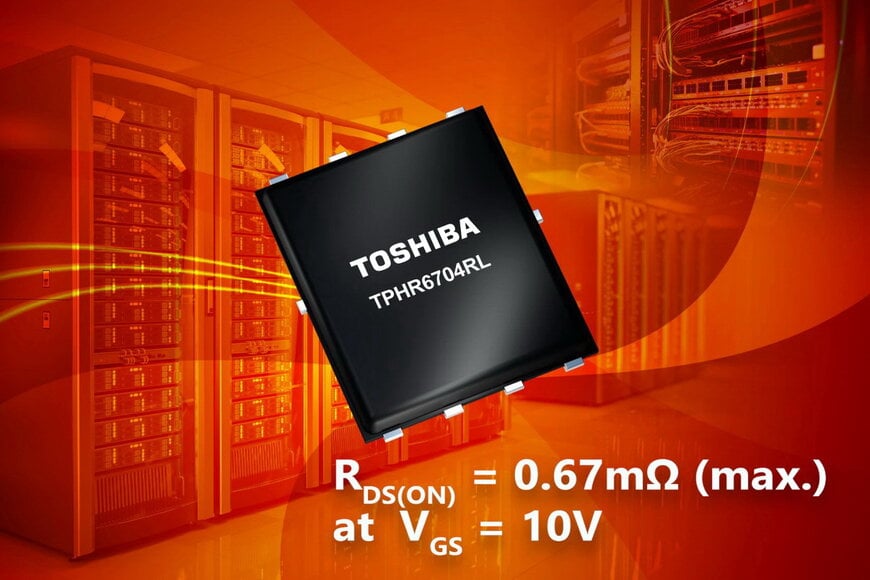
The TPHR6704RL utilizes the latest-generation U-MOS11-H process to reduce conduction and switching losses in high-frequency applications, including data center power distribution units, DC-DC converters, and motor drivers. This advancement addresses the increasing demand for high-efficiency voltage regulation in environments where thermal dissipation and electromagnetic interference (EMI) are primary design constraints.
Technical Optimization via U-MOS11-H Process
The transition to the U-MOS11-H fabrication process enables a significant reduction in drain-source on-resistance (RDS(ON)). The TPHR6704RL specifies a typical RDS(ON) of 0.52mΩ at a gate-source voltage VGS of 10V, with a maximum limit of 0.67mΩ. When compared to the preceding U-MOS IX-H based model (TPHR8504PL), this represents a 21% decrease in resistance.
Beyond static conduction losses, the device improves dynamic performance through reduced charge characteristics. The typical total gate charge (Qg) is 88nC, and the gate switch charge (QSW) is 24nC. These parameters result in a 37% improvement in the RDS(ON) × Qg figure-of-merit (FoM). A lower FoM indicates a more efficient trade-off between conduction and switching losses, which is critical for maintaining high efficiency in high-speed switching circuits.
Thermal Management and Current Capacity
Industrial and data center applications require stable operation under high-load conditions. The TPHR6704RL supports a drain current (ID) rating of up to 420A. To manage the heat generated at these current levels, the device features a channel-to-case thermal resistance of 0.71°C/W at 25°C.
The maximum channel temperature (Tch) is rated at 175°C, providing a wider operating margin for digital supply chain hardware located in harsh industrial environments or high-density server racks. Furthermore, the design of the MOSFET minimizes voltage spikes between the drain and source during switching transitions, which directly assists in the reduction of EMI without requiring extensive external filtering.
Integration and Verification Tools
The device is housed in an SOP Advance (N) package, maintaining footprint compatibility with standard SOP Advance designs to facilitate direct board-level upgrades. To assist in the integration process, Toshiba provides two tiers of simulation support. The G0 SPICE models allow for rapid functional verification, while high-accuracy G2 SPICE models are intended for detailed analysis of transient and switching characteristics. These tools enable engineers to calculate expected efficiency and thermal performance prior to physical prototyping.
Comparative Performance Analysis
In the context of 40V power MOSFETs, the TPHR6704RL is positioned against established benchmarks using the U-MOS IX-H series. The primary differentiator is the 37% reduction in the RDS(ON) × Qg figure-of-merit. While the previous generation provided a baseline for industrial switching, the U-MOS11-H process specifically targets the reduction of parasitic parameters that previously limited switching frequency and thermal efficiency in sub-milliohm resistance devices.
Edited by Evgeny Churilov, Induportals Media - Adapted by AI.
www.global.toshiba
