
electronics-journal.com
01
'26
Written on Modified on
Compact 3-axis vibration sensing for condition monitoring
STMicroelectronics introduces a wide-bandwidth MEMS sensor to improve accuracy and integration in industrial and automotive condition monitoring systems.
www.st.com
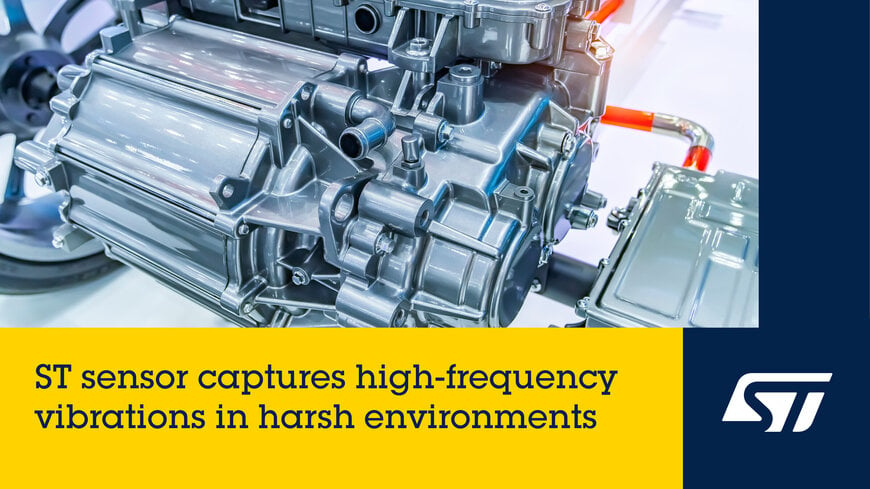
A new 3-axis MEMS vibration sensor from STMicroelectronics integrates multi-axis sensing, wide bandwidth, and high thermal stability to support condition monitoring in industrial equipment and automotive power electronics.
Design integration and application scope
The IIS3DWBG1 combines three-axis vibration sensing within a single digital device, reducing component count and simplifying system design in applications such as smart motors, gearboxes, and automotive traction systems. By consolidating sensing functions, the device contributes to a more efficient digital supply chain through lower bill-of-materials requirements and reduced assembly complexity.
Its compact 2.5 mm × 3 mm LGA-14L package allows placement close to critical measurement points, which is essential for accurate vibration diagnostics. This is particularly relevant in industrial condition monitoring systems, where sensor positioning directly affects measurement fidelity. The device supports operation across a temperature range of −40°C to 125°C, enabling deployment in environments such as hybrid powertrains and power electronics modules.
Measurement performance and diagnostic capability
The sensor features a flat frequency response from DC to above 6 kHz (−3 dB), allowing detection of both low-frequency structural vibrations and higher-frequency signals associated with early-stage faults. A noise density of 75 µg/√Hz in 3-axis mode supports detection of small-amplitude vibrations, which are often indicative of developing issues such as bearing wear, misalignment, or mechanical looseness.
These characteristics enable monitoring not only of rotating machinery but also of electromechanical components including coils, transformers, busbars, connectors, and snubber capacitors. In automotive systems, this extends diagnostic coverage to traction inverters and other power modules, supporting predictive maintenance strategies within the automotive data ecosystem.
Stability and embedded processing features
The IIS3DWBG1 maintains stable sensitivity across its operating temperature range, eliminating the need for end-of-line calibration in many applications. This reduces system commissioning time and simplifies deployment in large-scale industrial installations.
Integrated digital features include configurable low-pass and high-pass filters with selectable cutoff frequencies, an embedded FIFO buffer, interrupt generation, a temperature sensor, and self-test functionality. These capabilities allow preprocessing of vibration data at the sensor level, reducing the computational load on host systems and enabling more efficient edge analytics.
Reliability and system-level benefits
The device is designed to withstand high mechanical shock, supporting use in harsh industrial and automotive environments. Its low power consumption makes it suitable for battery-powered monitoring systems, where long operational life is required without frequent maintenance.
By combining multi-axis sensing, high bandwidth, and embedded signal conditioning in a compact form factor, the sensor supports earlier fault detection and improved maintenance planning. This contributes to reduced downtime and more predictable operation of both industrial machinery and electrified vehicle systems.
Edited by an industrial journalist Sucithra Mani with AI assistance.
www.st.com
