
electronics-journal.com
01
'26
Written on Modified on
Automotive inertial module improves GNSS positioning accuracy
STMicroelectronics introduces a high-temperature automotive IMU combining synchronized MEMS sensing and sensor fusion support for navigation, telematics and vehicle motion analysis.
www.st.com
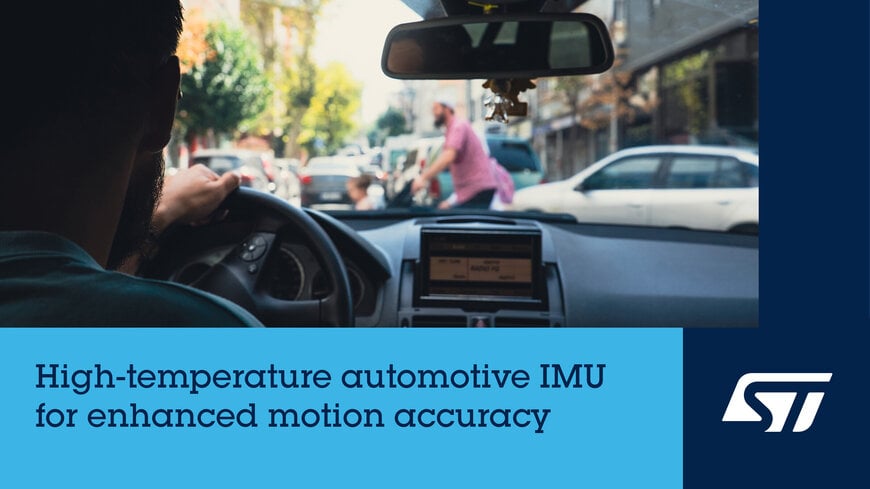
STMicroelectronics has introduced the ASM330LHHG1 automotive inertial measurement unit (IMU), a six-axis MEMS sensor module designed to improve dead-reckoning accuracy and motion sensing performance in connected and autonomous vehicle applications. The module integrates a three-axis accelerometer and three-axis gyroscope with synchronized outputs, enabling more precise positioning when GNSS signals are unavailable, degraded or temporarily interrupted.
The device targets automotive, industrial and agricultural vehicle platforms requiring continuous navigation, motion tracking and sensor fusion capabilities. Applications include advanced driver assistance systems, telematics, V2X communication, eTolling, anti-theft monitoring and crash-event analysis.
Six-axis MEMS architecture supports dead-reckoning systems
The ASM330LHHG1 combines a low-noise three-axis accelerometer with a three-axis gyroscope inside a compact automotive-qualified package. Both sensing elements use STMicroelectronics’ MEMS manufacturing processes and incorporate integrated temperature compensation to maintain measurement stability across an extended operating range from -40°C to 125°C.
The module delivers synchronized six-channel output data, allowing accelerometer and gyroscope measurements to remain time-aligned. This synchronization is critical for dead-reckoning algorithms, motion-data correlation and GNSS sensor fusion systems that calculate vehicle position between satellite updates.
As modern navigation systems increasingly depend on continuous positioning information, dead-reckoning technologies provide a fallback mechanism during GNSS signal loss caused by tunnels, urban canyons, electromagnetic interference or satellite signal corruption.
Extended measurement ranges for automotive motion analysis
The accelerometer supports selectable measurement ranges up to ±16 g, while the gyroscope covers angular-rate ranges from ±125 degrees per second to ±4000 degrees per second. These specifications allow the module to operate across a broad range of vehicle dynamics scenarios, from routine driving maneuvers to impact detection and vibration analysis.
According to STMicroelectronics, the sensor architecture has been optimized to minimize noise and bias drift while improving output stability. Embedded temperature compensation further reduces measurement deviations caused by thermal variation within automotive environments.
The module can support applications such as vehicle-to-everything (V2X) systems, telematics platforms, electronic toll collection, crash reconstruction, driving comfort optimization and vibration monitoring. These functions increasingly rely on accurate motion sensing and continuous vehicle-state awareness.
Low-power operation and automotive system integration
The ASM330LHHG1 includes dual operating modes supporting both high-performance and low-power system requirements. This allows vehicle manufacturers to optimize energy consumption depending on application priorities and power-management strategies.
For system integration, the module supports I²C, SPI and MIPI I3C interfaces. A built-in 3 KB FIFO buffer enables local data storage, reducing processor workload and lowering overall system power consumption.
The device is qualified according to the AEC-Q100 automotive reliability standard and is supplied in a compact 2.5 mm × 3.0 mm LGA-14L package. Automotive qualification allows deployment in vehicle zones exposed to elevated temperatures and harsh operating conditions.
Automotive positioning systems and sensor fusion requirements
The growing adoption of software-defined vehicles and advanced driver assistance systems has increased demand for highly accurate automotive inertial sensing. Sensor fusion architectures combine GNSS data with accelerometer and gyroscope measurements to improve positioning continuity and reliability.
Automotive data ecosystems increasingly rely on synchronized inertial measurements to support navigation, localization, predictive maintenance and vehicle dynamics monitoring. In electric and autonomous vehicle platforms, inertial measurement units are becoming critical components for maintaining operational awareness when external positioning signals become unavailable.
Additional Context: This section details technical specifications and competitive benchmarking not included in the original product announcement
The ASM330LHHG1 belongs to a growing category of automotive-grade MEMS inertial sensors designed for dead reckoning and sensor fusion applications. The device provides six-axis sensing with synchronized outputs, operating across a temperature range of -40°C to 125°C while supporting acceleration ranges up to ±16 g and gyroscope ranges up to ±4000 dps.
Comparable automotive IMUs include the Bosch SMI230, Murata SCH16T-K01 and Analog Devices ADIS16507 series. These devices are commonly evaluated according to measurable parameters such as noise density, bias stability, temperature drift, synchronization accuracy and operating temperature range.
The Murata SCH16T-K01, for example, is widely used in automotive positioning systems and offers bias stability optimized for dead-reckoning applications, while Analog Devices ADIS16507 integrates precision inertial sensing for industrial and autonomous navigation systems. Bosch’s SMI230 targets automotive safety and motion-control applications using MEMS accelerometer and gyroscope integration.
Compared with conventional standalone accelerometers and gyroscopes, synchronized six-axis IMUs reduce timing mismatches between sensor channels and improve sensor-fusion calculations. This becomes increasingly important in advanced GNSS fusion systems used for lane-level positioning, autonomous navigation and connected vehicle services.
The addition of MIPI I3C support in the ASM330LHHG1 also aligns with industry migration toward higher-speed automotive sensor communication architectures, reducing latency and improving interoperability within next-generation vehicle electronics platforms.
Edited by Sucithra Mani, Induportals editor – adapted by AI.
www.st.com
