
electronics-journal.com
16
'26
Written on Modified on
ROHM Unveils Wide-SOA MOSFET for Automotive Safety Circuits
The 100V RS4P063BPHZG suppresses secondary breakdown, delivering five times the SOA tolerance in a standard 5060 package.
www.rohm.com
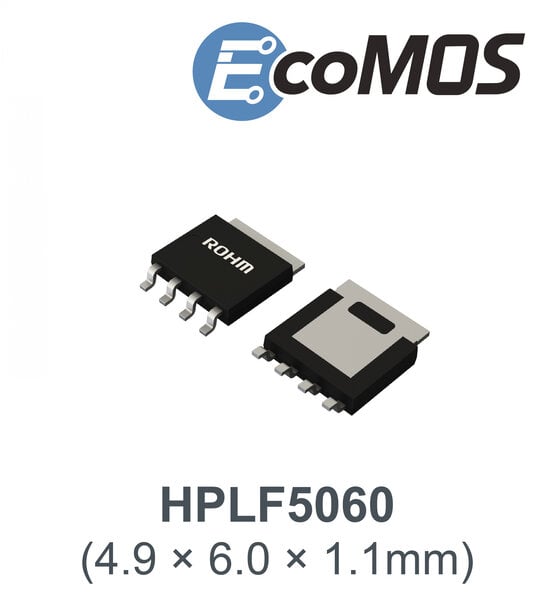
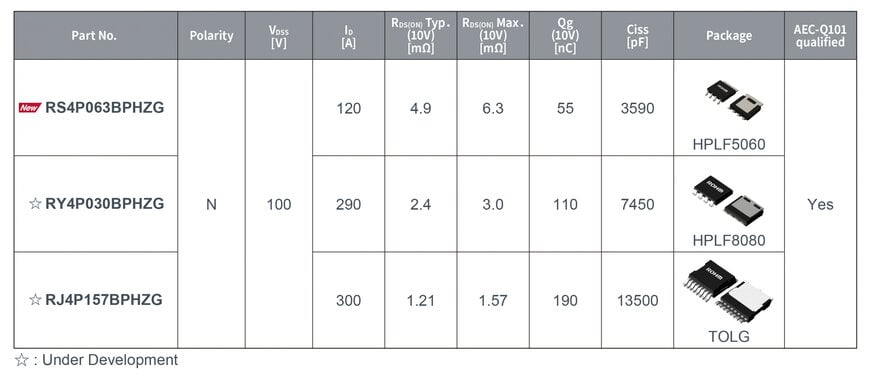
ROHM has introduced the RS4P063BPHZG, a new 100V MOSFET optimized for automotive safety functions and protection circuits. Packaged in the industry-standard 5060 size (HPLF5060), the device achieves an industry-leading Wide Safe Operating Area (SOA). By incorporating a proprietary design that effectively suppresses secondary breakdown, the MOSFET delivers approximately five times the SOA tolerance of standard, equivalent-sized products under conditions of 100V drain-source voltage (VDS) and a 100µs pulse width.
This expanded SOA capability enhances the reliability of automotive systems exposed to momentary high-power loads, such as airbag inflator ignition circuits, seatbelt pretensioner drives, and pyro-fuse cutoff circuits for battery isolation. Utilizing the widely adopted 5.0 × 6.0 mm package size allows automotive engineers to easily drop the new MOSFET into existing PCB layouts, reducing the workload and costs associated with extensive design modifications. Mass production of the RS4P063BPHZG began in June 2026, with availability through major distributors. ROHM is currently developing additional Wide-SOA MOSFETs in larger HPLF8080 (8.0 × 8.0 mm) and TOLG (9.9 × 11.7 mm) packages to further expand its automotive safety portfolio.
Additional Context
This section provides technological and market background not explicitly detailed in the original release.
The Safe Operating Area (SOA) defines the strict voltage and current boundaries within which a power semiconductor can operate without suffering irreversible damage. Historically, secondary breakdown—a catastrophic failure mode driven by localized current concentration and thermal runaway (hotspots)—was primarily associated with bipolar transistors. However, as modern MOSFETs have scaled down to achieve lower on-resistance, they have become increasingly susceptible to similar thermal instability under high-voltage, high-current stress. In safety-critical automotive applications, such as deploying airbags or triggering pyro-fuses to instantly disconnect EV batteries during a collision, the switching components must survive massive, millisecond-duration power surges. By re-engineering the silicon structure to suppress these localized hotspots, ROHM has pushed the thermal limits of the SOA outward. This allows Tier 1 suppliers to utilize smaller, surface-mount packages to handle extreme transient loads, saving valuable board space without compromising safety.
Edited by Lekshman Ramdas, Induportals editor – adapted by AI.
www.rohm.com
